
Training guide · Warm-up
Climbing warm-up: 10- and 20-minute routines for bouldering and the hangboard
A ready warm-up step by step, a version before bouldering, a version before the hangboard, and the mistakes that waste it


Build your training yourself or with a coach.
In short
- One order every time: raise your pulse, move your joints, climb easy, then make the holds smaller. Hard moves come last.
- 10 minutes covers an easy or moderate session. 20 minutes fits before limit bouldering, a board session or the hangboard.
- Fingers warm up in steps. In one study, three different 10-minute warm-ups left finger flexor strength unchanged, so the finger part gets its own build-up.
- Keep static stretches short and follow them with movement.
A climbing warm-up takes you from the changing room to your first hard move with your shoulders moving freely and your fingers ready for small holds. Below are two ready routines, a 10-minute and a 20-minute one, plus the changes for a bouldering session and for a hangboard session. The sets, times and rests in the routines are common coaching ranges. Measured facts from studies are in the science section, with sources at the end.
The 10-minute climbing warm-up
Use it before an easy or moderate session, or on a day with little time.
- Minutes 0–2, pulse. Skipping, jogging on the spot or an easy row, until you breathe a little harder.
- Minutes 2–4, joints. 10 arm circles each way, 10 shoulder blade squeezes, 10 wrist circles each way, 10 slow fist open-and-close, 10 bodyweight squats.
- Minutes 4–10, easy climbing. 3 or 4 easy climbs or a long traverse on big holds, well below your limit, with about a minute between them. Make the last one a little steeper or on slightly smaller holds.
Then start the session at moderate grades and work up. Treat the first moderate climbs as the end of the warm-up.
The 20-minute climbing warm-up
Use it before a hard session: limit bouldering, board climbing, hard redpoint attempts or the hangboard.
- Minutes 0–3, pulse. As in the short version, a little longer.
- Minutes 3–7, joints and activation. Arm circles, 2 × 10 band pull-aparts, 2 × 10 band external rotations per arm, 5 scapular pulls hanging from big holds (straight arms, pull the shoulders down and back), wrist circles, leg swings and a few deep squats. More shoulder and antagonist work is in exercises for climbers.
- Minutes 7–12, easy climbing. 3 to 5 easy climbs on big holds with quiet feet, a minute or two between them.
- Minutes 12–17, smaller holds. 3 or 4 climbs that step the hold size down and the angle up, 2 to 3 minutes between them.
- Minutes 17–20, today’s movement. A few climbs or moves in the style of today’s main work, a couple of grades below it. Then rest for a few minutes before the first hard attempt.
Before bouldering
A bouldering warm-up has one extra job: hard bouldering puts high loads on fingers and shoulders within a few moves. Start from the 20-minute version and adjust it.
- Build a ladder. Pick 4 to 6 problems from easy to moderate and climb each once. Rest longer as they get harder.
- Rehearse the style of the day. A steep project calls for an easy steep problem in the ladder. Crimpy projects call for easy crimps, in an open hand or half crimp first.
- Add dynamic moves gradually. A few small, controlled moves between big holds come before full jumps and dynos.
- Check how it feels. If the ladder feels much harder than usual, make today a volume day on moderate problems.
Before the hangboard
The hangboard comes after a warm-up, at the start of the session, on fresh fingers.
- First the body. The 10-minute routine at the wall, or at home without a wall: pulse and joints, plus a few minutes of fist open-and-close and rolling a soft ball in each hand.
- Then build-up hangs on the edge and grip you will use today: 2 to 3 sets of 3 to 5 hangs of 7 to 10 seconds, with your feet on the floor or a chair taking part of the weight. Raise the effort set by set, with 1 to 2 minutes between sets.
- Finish lighter than your working load. The last build-up set should still feel clearly easier than your first working hang. Rest a few minutes, then start the working sets.
- Keep it identical each time. The same warm-up makes your hangboard numbers comparable from week to week.
What to do after the warm-up is covered elsewhere: a beginner routine in finger strength for climbing and four structured workouts in hangboard training. Heavy finger work such as max hangs is once a week by default. A second weekly session is for advanced climbers on a full training plan, with a rest day between.
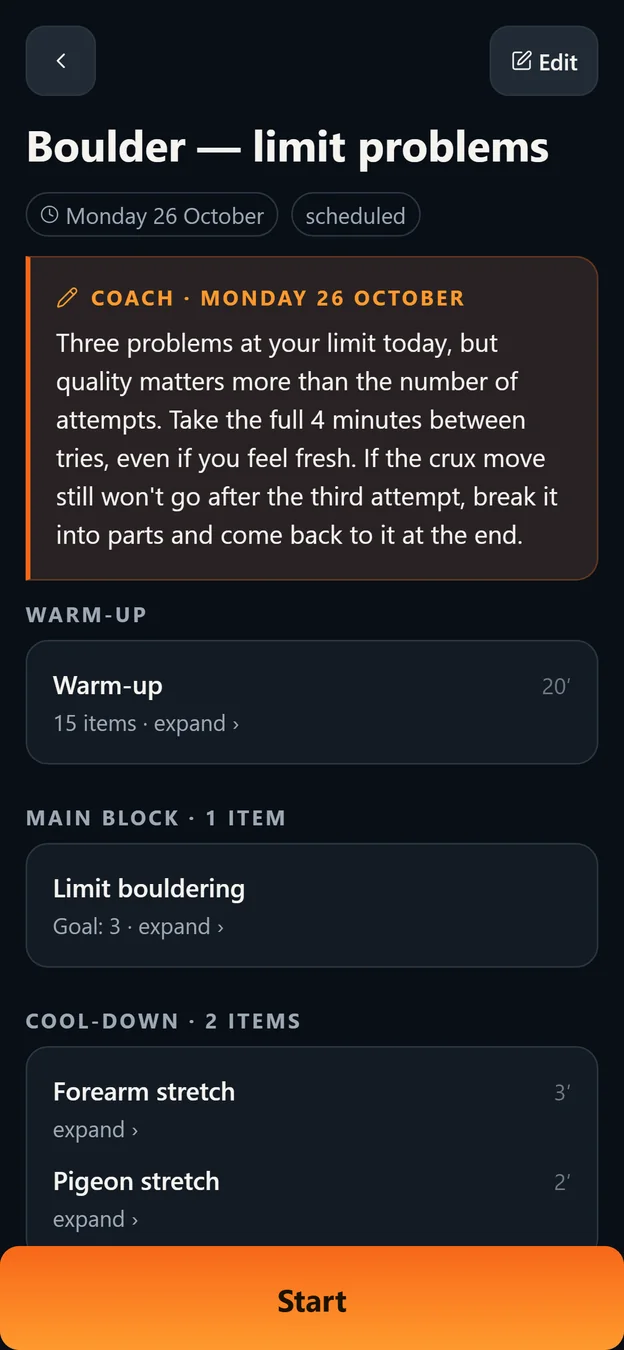
In the app: training sessions in ClimbingDad open with a warm-up block matched to the main work of the day. Before bouldering it ends with a traverse on big holds and a ladder of problems that gets harder step by step. Before the hangboard it ends with finger open-and-close and short hangs that step down from a 35 mm to a 20 mm edge. You choose a short or full version, tick each step off or skip it, and finish with a check: fingers warm, no crimp pain? If not, add 3 minutes. The hang and rest timer then runs the working sets.
Common mistakes
- Going straight to the project on cold fingers and cold shoulders.
- Long static stretches right before hard climbing. Keep holds short and move afterwards.
- Warming up into a pump. The warm-up should leave you fresh. If your forearms burn, the climbs were too hard or the rests too short.
- Skipping the smaller holds. Jumping from big holds straight to crimps leaves out the step your fingers need most.
- The same warm-up for every session. Before bouldering, rehearse the moves of the day. Before the hangboard, add build-up hangs.
- A rushed warm-up at home before hangboarding, with two quick hangs and straight into the working sets.
- A long break after warming up. If you sit for a long time before your first hard attempt, repeat a few easy climbs.
- Treating the warm-up as insurance. It prepares you for climbing. Pain still ends the session.
What a warm-up does
Warming up helps performance in most tests. A meta-analysis of 32 studies found that a warm-up improved performance in 79% of the measures examined, with little evidence that warming up harms. The studies covered many sports, with warm-ups that included more than stretching.
Long static stretches cost more than short ones. A systematic review found an average drop of 3.7% in performance tested straight after static stretching. Holding a stretch for 60 seconds or more per muscle group cost 4.6%, under 60 seconds cost 1.1%, and dynamic stretching gave a small gain of 1.3%. When movement followed the stretching, the review saw no clear effect on performance.
A general warm-up leaves finger strength unchanged. In a crossover study, 22 recreational climbers tried three 10-minute warm-ups: dynamic stretching with a resistance band, vibration rolling, and a climbing-specific one with traversing, short hangs on a 2.5 cm edge and easy routes. All three improved shoulder range of motion and upper body stability, and raised elbow flexor and shoulder extensor strength. None of them changed finger flexor strength, measured with a handheld dynamometer.
Warm-up habits and overuse injuries. A systematic review of 34 studies in adult climbers found no link between warm-ups, cool-downs or stretching and the risk of overuse injury. Higher climbing intensity, bouldering, lower finger strength, crimping and a previous injury were linked to higher risk. The review points to strength work, load management and climbing technique as the targets for injury prevention.
Questions climbers ask
How long should a climbing warm-up be?
About 10 minutes before an easy or moderate session, and about 20 minutes before limit bouldering, a board session or the hangboard. In one study, each of three 10-minute warm-ups improved shoulder range of motion in recreational climbers.
How do you warm up your fingers for climbing?
Climb easy terrain on big holds first, then step the hold size down over several climbs. Before a hangboard session, add 2 to 3 sets of short build-up hangs with your feet taking part of the weight, raising the effort set by set.
Should you stretch before climbing?
Keep static stretches short and follow them with movement. In a systematic review, static stretches of 60 seconds or more per muscle group lowered performance more than shorter ones, and dynamic stretching gave a small gain.
What is a good bouldering warm-up?
Pulse and joint work first, then a ladder of 4 to 6 problems from easy to moderate that includes the style of today’s project, and a few controlled dynamic moves before the hard attempts.
Does a warm-up prevent climbing injuries?
No warm-up removes the risk. A systematic review of adult climbers found no link between warm-up habits and overuse injuries. Warm up to climb better, keep hard finger days apart, and stop at sharp pain, a pop or swelling.
Train and log with a coach
ClimbingDad is a free climbing training app for training on your own or with a coach. In the coach panel, a coach sees the warm-up block of every planned session and can change its sets and times, add or remove exercises, and drag items in or out of it. A note on the session reaches the climber before training starts. More on training with a coach.
About the author. Mateusz Kuba is a sport climbing instructor (instruktor sportu, sport climbing) with C4PC Level 1 — Strength Training for Youths. He coaches climbers on climbing walls in Warsaw and built ClimbingDad.
This page describes warming up in general terms. It is not medical advice and does not replace an examination by a doctor or physiotherapist.
What research says
The measured facts on this page come from these four papers. Only one of them tested climbers’ warm-ups directly, in recreational climbers:
- Warm-up and performance. 32 studies; a warm-up improved performance in 79% of the measures examined. Fradkin AJ, Zazryn TR, Smoliga JM. “Effects of warming-up on physical performance: a systematic review with meta-analysis.” Journal of Strength and Conditioning Research, 2010. 10.1519/JSC.0b013e3181c643a0 (PMID 19996770)
- Stretching before activity. Static stretching −3.7% on average, −4.6% at 60 s or more per muscle group, −1.1% under 60 s; dynamic stretching +1.3%. Behm DG, Blazevich AJ, Kay AD, McHugh M. “Acute effects of muscle stretching on physical performance, range of motion, and injury incidence in healthy active individuals: a systematic review.” Applied Physiology, Nutrition, and Metabolism, 2016. 10.1139/apnm-2015-0235 (PMID 26642915)
- Three 10-minute warm-ups in climbers. 22 recreational climbers; shoulder mobility, stability and some upper body strength improved, finger flexor strength did not change. Han HP, Yang PS, Lee CL, Chang NJ. “Comparing The Effectiveness of 10-Minute Dynamic Stretching, Vibration Rolling, and Climbing-Specific Warm-Ups on Exercise Performances in Rock Climbers.” Journal of Sports Science and Medicine, 2025. 10.52082/jssm.2025.84 (PMID 40046228)
- Overuse injury risk in adult climbers. 34 studies; warm-ups, cool-downs and stretching showed no link with overuse injury risk. Quarmby A, Zhang M, Geisler M, Javorsky T, Mugele H, Cassel M, Lawley J. “Risk factors and injury prevention strategies for overuse injuries in adult climbers: a systematic review.” Frontiers in Sports and Active Living, 2023. 10.3389/fspor.2023.1269870 (PMID 38162697)