
Hangboard training, and who each workout is actually for
Four workouts, what each one trains, who each one is for — and what the research behind them measured
A hangboard — or fingerboard — loads your fingers at a number you choose, on an edge you choose, for a time you choose. That precision is the value and the risk. So every plan below says who it is for — what suits a climber with four years on the wall can be wrong for one in their first season, and neither of them is “most climbers”.
Before you hang: who a hangboard is actually for
When you are ready to start hangboarding
Eric Hörst is direct about the lower bound: hangboarding is not appropriate for true beginners. A new climber gets more from climbing than from hanging, and finger tissue that has never been loaded hard has no history to judge itself against.
Where the line sits exactly is not a research finding. Our judgement, not a study: start once you have climbed regularly for around a year and can name fingers — not footwork, not fear, not shoulders — as the thing actually holding you back. If you cannot name what is holding you back, that is the answer.
What a hangboard cannot give you
It trains maximum finger force on a fixed edge in a fixed position. Not contact strength on slopers, not body tension, not the judgement to know when a move is on. A climber stuck because they climb tensely gets a better number on the board and the same result on the project.
How fingers actually get hurt, and what that means for grip choice
Crimp versus open hand, measured on fingers from donated bodies
The clearest evidence on grip position comes from pulling fingers from donated bodies until something tore. The A4 pulley tore in 50% of crimp trials and never once in open hand.
The forces are the ones each pulley was carrying at the point of failure, and in crimp they were far higher: A2 took 287 N — about 29 kg of pull — against 121 N, about 12 kg, in open hand, and A4 took 226 N against 103 N (Schöffl et al., Journal of Biomechanics, 2009). That makes the grip you train a safety decision before a performance one.
What actually tears a pulley is a sudden load
Pulleys rarely fail because someone hung patiently on an edge. They fail when a crimped finger is shock-loaded — a foot slipping, a dynamic move caught badly.
The next numbers are loads a pulley carries while you climb, not forces that tore it: A2 carries around 380 N, about 39 kg, in normal climbing and up to 450 N, about 46 kg, when it is shock-loaded, and at peak a full crimp can put up to 36 times the load on A2 that an open hand does (Larsson et al., 2022; Miro & Schöffl, 2021).
Keep it in proportion. Finger injuries are the most common injury climbers get that other people do not, and the one most likely to keep you off the wall — not the most severe. Those are lower-limb injuries from falls.
The UIAA, mountaineering's international body, rates injury severity from 1 to 6 and puts a torn pulley at 2: “heals without permanent damage”. Fingers are the most commonly injured body part for men; in the largest samples, shoulders are for women.
Half crimp on a 20 mm edge as the default
Lattice test and train on a 20 mm edge and their finger-strength dataset is built on it. They treat half crimp as the base position: full crimp loads the last knuckle in each finger harder, open hand puts more of the work on the tendons running down into your forearm. For an adult starting structured finger work that is the sane default — held the same way every session, so the number means something.
The case against that default is worth stating: small incut edges are climbed in full crimp, so a position you use on rock arguably deserves training. Our judgement is that the failure numbers above outweigh it — half crimp on 20 mm is the base, and full crimp under load is a deliberate, small-dose exception rather than a default.
What hangboard training actually improves, and how fast
Four weeks, three intensities
The most useful single trial ran four weeks with 54 climbers on a 12 mm edge, two sessions a week, at three intensities (Devise et al., Frontiers in Sports and Active Living, 2022). Note the edge: 12 mm is smaller than the 20 mm this article recommends you train on, so the trial was run on what it treats as a progression.
Hangs at full effort improved maximum force by 12.4%. Repeaters at 80% of maximum improved it by 5.9%. The 60% group's change in maximum force was small enough that it could have been chance — what statisticians call not statistically significant. That is not the same as doing nothing: the lighter groups were the ones whose endurance improved.
Across four-week studies the gain lands around 6–12.4% more force on the measuring device. Whether it shows up in your climbing grade is unproven: none of those studies measured climbing performance. Anyone promising you a grade is guessing past what was measured, and should say so.
The collagen argument and the asterisk it carries
The case for short, frequent, light loading rests on collagen — the stuff tendons are built from. Roughly ten minutes of loading is all it takes to switch on the repair process that builds new collagen, and for about six hours after that the tissue stops responding to more (Baar, Sports Medicine, 2017).
Hence ten-minute doses, six hours apart. The asterisk belongs every time — that was shown in human ligament tissue grown in a dish in a lab, not in the fingers of a living person.
The four hangboard workouts worth knowing
Four hangboard workouts cover almost everything anyone actually does. Each names who it is for.
Max hangs
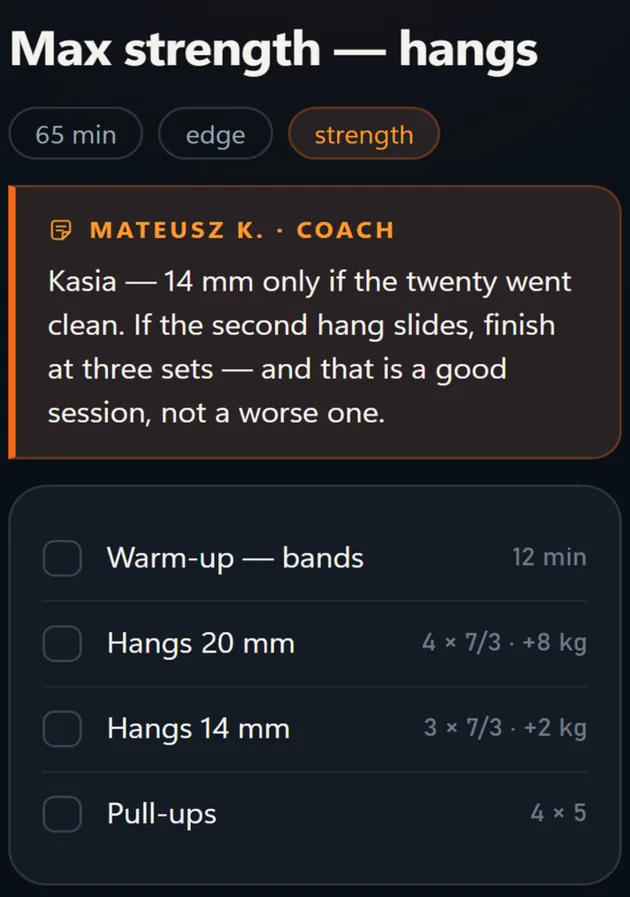
Heavy, short, long rests — the strongest evidence for raising maximum finger force, and a protocol for climbers with a training base rather than first-timers. Eva López prescribes 5–15 second hangs with 3–5 minutes between sets, stopping about three seconds before failure. Hörst's rests are a similar shape: 1–3 minutes between max hangs, 3–5 between sets.
The Anderson brothers split by level, which is the right instinct. Advanced: 7-second hangs with 3 seconds between one hang and the next inside a set, reps descending 7→6→5 across three sets per grip position, six grip positions, two minutes of rest between sets on the same grip and three minutes before moving to the next grip, with the added weight going up across the sets.
Those 3 seconds are a micro-rest inside a set; the long rests this workout is named for are the two and three minutes between sets.
Beginner: one set of five 10-second hangs per grip, across six to ten grips. Running the advanced version because you can survive it is the commonest error here.
Hangboard repeaters
Shorter rests, more time under tension, a load below your maximum. In the four-week trial above, repeaters at 80% produced 5.9% on maximum force — less than max hangs — while the lighter groups gained endurance. They are for climbers whose failure mode is a forearm that fills on a long boulder or a sustained route, not a single move they cannot hold. They cost more recovery than the set count suggests.
Density hangs — the hardest of the four, not the gentlest
As Tyler Nelson prescribes them they are 20–40 second holds at roughly 40–70% of your maximum, taken to failure, progressed by adding time or shrinking the edge.
At the bottom of that range it is the same 40% the light twice-daily holds below use, held two to four times as long and taken to failure — which is the whole difference between them. The load is modest; the demand is not. A 30-second hold to failure is the most punishing item here.
They suit climbers who want time under tension and can tolerate working to failure — not, whatever the low percentages suggest, someone returning from a finger injury.
Light twice-daily holds
The protocol popularised by Emil Abrahamsson: about ten minutes of light hanging — feet on the ground, around 40% of your maximum, on an 18–22 mm edge — twice a day, at least six hours apart.
Be precise about the evidence. Someone went back through training logs that 526 climbers had already kept, rather than running a study that told climbers what to do and watched what happened (Gilmore, Klimek, Abrahamsson & Baar, Sports Medicine – Open, 2024).
The light-holds-only group's change was not statistically significant. Max hangs alone was. Doing both beat either alone.
No controlled trial has settled whether two hard days a week or ten light minutes most days is the better use of a week. The protocol's creator was an author on the paper, which is a reason to read the result carefully rather than to dismiss it. File it as a cheap extra with a believable reason it should work and thin proof that it does — useful for climbers who cannot tolerate heavy loading.
Putting it in a week
First block
For an adult past the beginner stage, running structured finger-strength training for the first time: two sessions a week, on days when you are fresh, before the climbing rather than after it. Start with the Andersons' beginner shape.
Use one grip position rather than the six to ten they list — half crimp on 20 mm. One block, one edge, one grip, one protocol, so that if something changes you know what changed. Add grip positions in a later block, once the load on the first one is steady.
Established climber in a strength block
Hörst's frequency guidance: two days a week, three at most if you are doing no other climbing. The three-day version is a specific case, not an upgrade — it assumes the hangboard carries all your finger load. If you also climb three or four times a week, two sessions with a full day between them is the version that fits. Our judgement, not a study: when the week collapses, drop the hangboard rather than the climbing.
Heavy climbing weeks and trips
On a trip, or a week of hard outdoor days, the climbing is already loading your fingers hard enough. Max hangs on top add risk and almost nothing you can measure. Cut finger training to zero, or keep only the light ten-minute work if you already run it and it costs nothing on the rock.
Progressing the load
Add weight, or shrink the edge?
Eva López separates these cleanly. Her minimum edge depth method shrinks the edge with no added weight. Her maximum added weight method adds weight on a fixed edge — her worked example uses 18 mm.
Added weight gives a cleaner number to track and does less damage to your skin, which suits most adults on 20 mm. Shrinking the edge trains the small-edge position directly, at the cost of a moving target: change the edge and every earlier number stops being comparable. Do not do both in one block.
Stop three seconds before failure — and where that rule doesn't apply
López's rule is the right default for max hangs and repeaters: it keeps the worst repetitions, where body position collapses, out of your training. It explicitly does not apply to density hangs, which are prescribed to failure by design.
Two protocols, two rules — knowing which one you are running matters more than either. The failure is drifting to failure inside a protocol written to stop short of it: you are a second off the time on the screen, and you squeeze for it.
Warning signs, and how much pain is allowed
The 5-out-of-10 rule
The most usable rule comes from rehab for long-running tendon pain: pain up to 5 out of 10 during or immediately after loading is acceptable, provided the finger is back to however it felt before you trained by the next morning (Silbernagel et al., American Journal of Sports Medicine, 2007).
Two caveats, neither small. It was developed for the Achilles — there is no finger-specific validation of it. And it covers pain from tendons being worked steadily and progressively, not sharp pain in one exact spot that arrived on a particular move. Pain that turned up mid-move, on one finger, is a thing to get looked at rather than a number to score.
What ends the session and what ends the block
- Ends the session — sharp, point-specific pain; an audible pop; swelling; a grip that suddenly cannot hold what it held four minutes ago.
- Ends the block — pain still worse than before the session the next morning, session after session; a maximum going backwards across two weeks; a finger that only feels normal on the days you do not climb.
A block cut short at week five because you noticed something costs you a fortnight. An A4 you kept loading costs you the season.
Logging your hangboard sessions in ClimbingDad
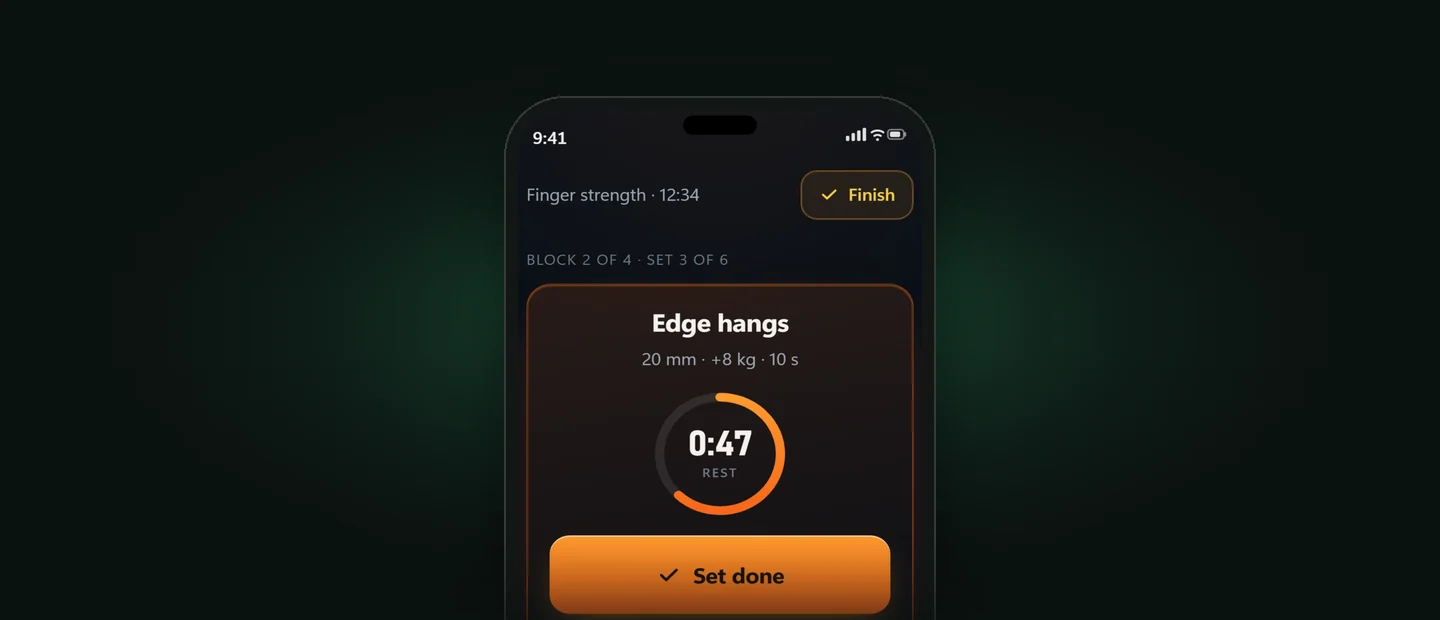
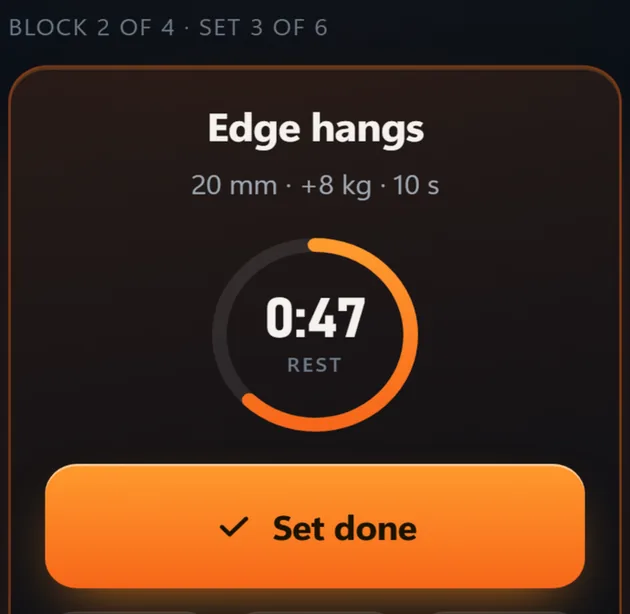
The app prescribes the session before you start — sets, reps, hang and rest seconds, edge width in millimetres, added load — so you are not doing arithmetic with chalky hands. Two timers do the counting: one for hangs and micro-rests inside a set, one for rest between sets. Each session records the load you actually used, which is what sets the next one. Finger load feeds the readiness score. How readiness works.
Questions climbers ask
What edge size should I use?
For adults training half crimp, 20 mm — Lattice test and train on it and their dataset is built on it. Eva López's added-weight example uses 18 mm; the light twice-daily protocol specifies 18–22 mm. Smaller edges are a progression method, not a starting point.
Can I hangboard on a climbing day?
Yes — for an adult running two finger sessions a week alongside three or four climbing sessions it is usually the practical option. Put it after a full warm-up and before the hard climbing, and accept that the climbing suffers a little. What does not work is hangboarding as a finisher.
How long before I feel it on the wall?
The maximum load you can hang goes up in roughly four to eight weeks. Whether that reaches your grade is unproven — none of those studies measured climbing performance. Treat the board number as the thing you trained, and the grade as a separate question.
Are no-hangs a substitute?
Standing on the floor and pulling up on a fixed edge with weight hung off it loads the same tissue with the same control and takes the shoulders out of it. Timings and progressions carry across. No study here compared the two head to head, so it is fair to assume they are the same and wrong to say it has been shown.
Train the fingers you have, not the ones in the study
Every number here came from a specific group of climbers under specific conditions. You are a group of one. Pick the protocol that matches who you are, run it long enough to mean something, write down what you actually did — and stop early on the day a finger tells you to. See how ClimbingDad handles the logging.