
Strength training for climbers: what it does, what it does not, and what to actually do
The two things the research recommends, and the four it has never tested
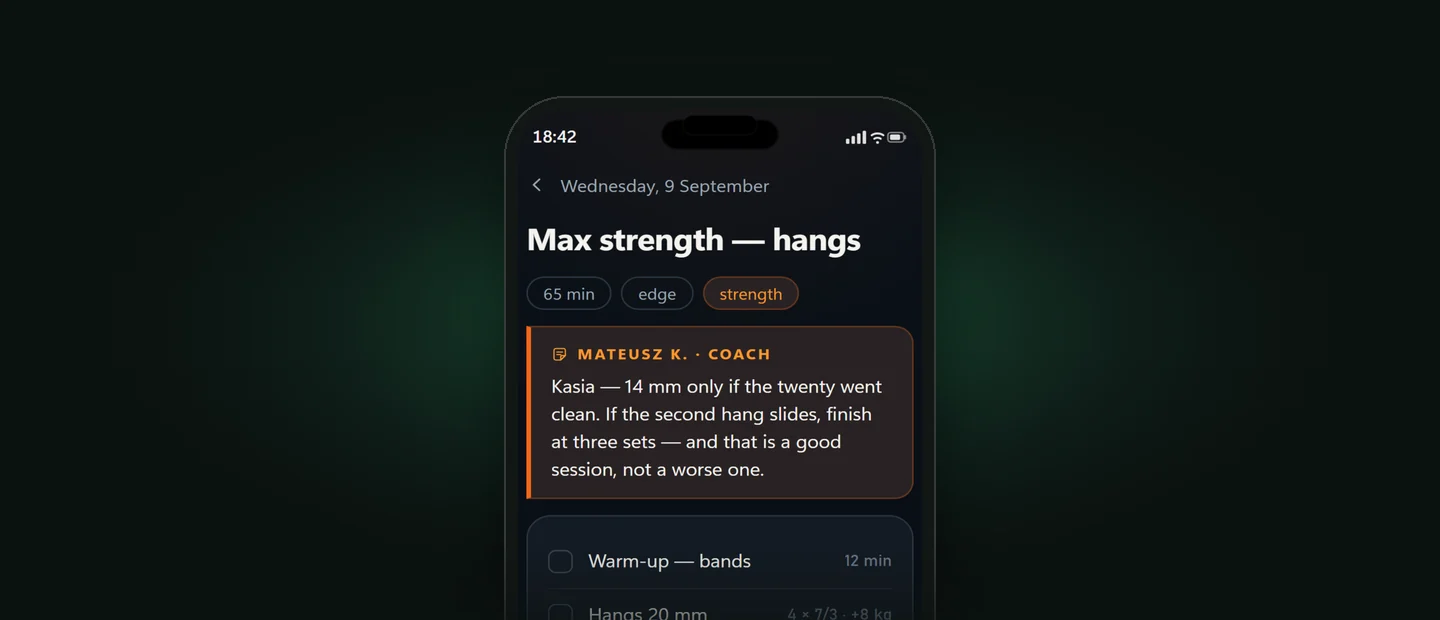
Does lifting make you a better climber? Your fingers and forearms get stronger, yes. Whether you climb harder, nobody has shown.
The big reviews say it helps. One of them added up five studies where some climbers trained in the gym and some only climbed: the ones who trained did better on the strength tests (Stien, Riiser, Shaw, Saeterbakken & Andersen, 2023).
Then somebody put climbers on real boulder problems, and the answer split in two. Campus board twice a week for five weeks made people climb harder boulders than a group who just kept climbing (Stien, Pedersen, Vereide and colleagues, 2021). Five weeks of finger training changed nothing on the wall (Saeterbakken, Bratland, Andersen & Stien, 2024), and a trial with 31 women found almost nothing either way (Langer, Andersen & Stien, 2024).
So one thing worked and one did not — and the same research group ran both. None of these trials lasted long enough to watch anyone’s grade go up.
That is less than the internet promises you, and here is why. Count every strength study ever done on climbers and you get about a dozen. They last five to ten weeks. Most have twenty or thirty people in them. And each one tests a single exercise, never a whole gym session the way you would actually train.
One more thing before the rest. In 246 studies of good climbers, only 22.7% of the people tested were women, and only 34 of those studies looked at women and men separately (Langer, Roffler, Hief & Fleddermann, 2025). If you are a woman, most of what follows was measured on somebody else.
Should any of your week be in the gym?
Work backwards from what stops you on your project. Not from what a programme says you should be doing.
- You fall because a hold is too small or too bad. That is finger strength, and it is the one area with real evidence behind it. Twice a week on an edge — the hangboard guide has the protocols. The gym is not the answer here; a fingerboard is.
- You fall late on long boulders, forearms full. Forearm endurance had the largest effect of anything measured in the meta-analysis above. Climbing more, on easier ground, for longer, is the cheapest way to train it.
- You fall because you cannot hold a position — a lock-off, a heel, a wide span. This is the one that sends people to the gym, and it is the one with the least evidence. Pulling strength trains on the wall too. Try that first for a block.
- Your shoulders or elbows hurt, or you want them not to. Go to the gym. See below for why the reason is anatomy rather than proof.
- You fall off because you are scared, or read the sequence wrong, or your feet cut. No amount of strength fixes any of those, and this page cannot help you. That is not a joke — it is the most common answer.
If you land on the first two, most of your week still belongs on the wall. The gym is a supplement to climbing, not a swap for it. One trial did try the swap — 31 women doing gym work, wall work or neither for five weeks — and could not separate them (Langer, Andersen & Stien, 2024).
What the research actually recommends
Search for exercises for climbers and you get long lists. The research gives you two things, and these are them — short, but somebody actually tested them.
Twice a week, heavy, brief. The review puts it this way: “structured low-volume high-resistance training, twice per week hanging from small ledges or a fingerboard, is a feasible approach for climbers” (Saeterbakken, Stien, Pedersen and colleagues, 2024). Note what it is about: your fingers, on an edge. Not a leg day.
Hold positions and move through them, close to climbing. Mix static work with dynamic, and keep it near what climbing actually demands — not isolated machines (Langer, Simon & Wiemeyer, 2023).
Three things beat a control group in an actual trial, and each comes with a dose. Adding 1.25 kg a week to hangboard sets, over eight weeks, raised grip strength where an endurance protocol did not (Mundry, Steinmetz, Atkinson and colleagues, 2021).
Campus board twice a week for five weeks improved bouldering performance by a wide margin — and twice a week beat four times a week (Stien, Pedersen, Vereide and colleagues, 2021). Finger-extension work twice a week for four weeks raised extension strength 41% (Devise and colleagues, 2023).
Those are the only doses on this page that came with a control group attached. Everything else you have been told about sets and reps is somebody reasoning from a mechanism.
And put the hard thing first. Whatever exercise comes last in a session gets fewer repetitions and smaller strength gains than if you had done it first (Simão, de Salles and colleagues, 2012). That was measured in gym-goers rather than climbers, and the American College of Sports Medicine grades the same advice its lowest tier of evidence — but it is free to act on.
In practice: weighted pull-ups after two hours of projecting is a decision to train them badly.
Wrecked fingers are not a rest day
Minutes after bouldering until they chose to stop, 28 climbers had lost 34.2% of their finger-hang endurance — and only 4.8% of their explosive pulling power (Wilczyński, Nowosad and colleagues, 2026).
Fingers and pulling do not fall together. So the evening your fingers are gone is a reasonable evening to press, pull with your feet on, or do the shoulder work you keep skipping — and a bad one to hangboard. That is a reason, not a schedule. How readiness works.
Do pull-ups make you a better climber?
Pull-ups for climbing are the most-tested thing on this page, and the answer is still awkward. Pull-up endurance tracks climbing level about as well as finger-hang endurance does — correlations around 0.5 to 0.6 in 28 advanced men, where 1.0 would be a perfect match (Draga, Rokowski, Sutor and colleagues, 2024). How fast you can pull tracks nothing at all (Devise, Quaine & Vigouroux, 2023).
Tracking is not causing. Ten weeks of explosive upper-body work in 18 boulderers added about four pull-up repetitions and raised push-up power — and moved finger strength, the power slap and the jump not at all (Cortés-Roco and colleagues, 2026).
The authors’ own summary is the honest one: “preliminary evidence of movement-specific neuromuscular performance improvements”. Training a movement makes you better at that movement. Nothing further came with it.
Weighted pull-ups for climbing: what nobody can tell you
Added weight has been trialled. In 30 climbers over five weeks, one group trained slow lowering at 95% of their one-rep maximum, against a control that did nothing special; every training group improved its maximum by 2 to 5% (Vigouroux & Devise, 2024). Adding weight to a fingerboard beats not adding it, too (Mundry and colleagues, 2021).
Here is the gap. Nobody has trained climbers on ordinary weighted pull-ups — pulling up with weight on, rather than lowering slowly — and nobody has checked whether any of it shows up on the wall. So the “add 2.5 kg a week” someone sold you is a guess dressed as a plan.
So any percentage, any progression, any “add 2.5 kg a week” you have been given is somebody’s reasoning, not a result. It may well be good reasoning. It has not been tested.
Do core exercises for climbing do anything?
Nobody has compared core training against doing none. What has been compared is one kind against another, and they came out level.
Nineteen advanced climbers trained core twice a week for ten weeks, half with movement, half with held positions. Both groups improved on the climbing-specific tests and neither beat the other (Saeterbakken, Loken, Scott and colleagues, 2018). With no untrained group, the trial cannot say whether core work did anything at all.
The reason you have heard — core keeps your feet on when it steepens — is coaching logic. Plausible, unmeasured, and cheap enough that arguing about it costs more than doing it.
Shoulders and elbows: do them, but not for the reason you heard
Not because prevention is proven. It is not. Do them because climbing barely loads those muscles and that is where a third of climbing injuries land.
In 191 climbers, injuries ran at 5.2 per 1000 hours of climbing — at five hours a week, roughly one every nine months. Shoulders were 32% of them, elbows 16% (Hlebš & Brezovar, 2026).
The training does work, in the sense that it makes you stronger. Four weeks of finger-extension work raised extension strength 41% against a control group (Devise and colleagues, 2023), and eight weeks of shoulder-blade work cut pain in climbers who already had a sore shoulder (Zanjani and colleagues, 2024).
And one randomised trial did count injuries. Thirty elite climbers spent sixteen weeks on a structured prehab programme or their usual training, and the prehab group finished with fewer injuries and less time in discomfort (Qu and colleagues, 2025). It was a broad rehabilitation programme rather than antagonist work specifically, and thirty climbers is thirty climbers — but it is the closest thing to an answer that exists.
Pushing the other way: one survey found climbers who did prehab were not injured any less often — though people who have already been hurt are the ones most likely to be doing it.
Two reviews argue the mechanism is elsewhere entirely, and they contradict each other. One says prevention comes from building tolerance to load, and that lower-graded climbers should fingerboard less (Saeterbakken and colleagues, 2024). The other says weak fingers push the load onto your elbow and shoulder, and prescribes hangboarding as the protection (Kornienko and colleagues, 2026, grading their own advice the lowest tier on their scale).
Will weight training make you too heavy?
Nobody has tested it. The risk that has been measured runs the other way.
In 417 climbers, signs of under-fuelling went with reporting a current injury — about 38% more likely (Grønhaug, Slagel & Saeterbakken, 2026). The link weakened once disordered eating and low mood were accounted for, and an association is not a cause. It is still the only number anyone has here, and it points at being too light.
Elite climbers are leaner than national-level ones, with smaller arm and thigh girths. The people who measured that say: “The benefits of these characteristics and the influence of selection processes remain unclear” (Draga, Trybek, Baran and colleagues, 2025). Whether training built those bodies or the sport kept them, nobody knows.
The climbing review tells coaches to watch for periods stopping and for eating gone wrong. That is the harm somebody has actually measured — not a few kilos of back muscle.
What nobody has tested
Four gaps, in one place, so you can stop looking for answers that do not exist.
- Your legs. No dedicated leg-strength study in climbers exists. One plyometric trial measured a jump and it did not move. That is the state of the field, not a verdict against legs.
- A whole programme. Every study isolates one thing. Nobody has tested pulling, pressing, core and legs together, which is what a training week actually is.
- Your grade. Two trials measured bouldering performance and found no transfer; none has ever followed climbers long enough to see whether a grade moved. The usual outcomes are dynamometers, dead-hangs and move counts.
- Where the gym goes in your week. No per-system recovery rates exist for climbers, so nobody can tell you how long pressing muscles stay down.
Logging gym work in ClimbingDad
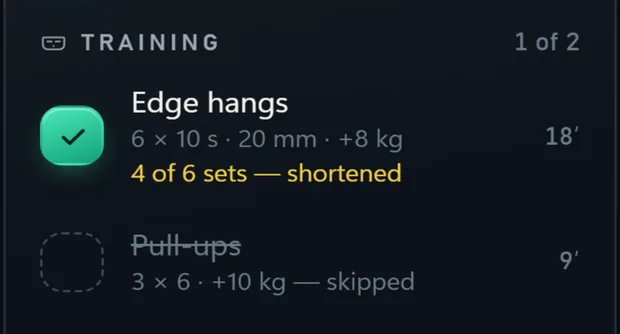
Gym is one of seven kinds of item you can log, alongside climbing, hangboard, campus, cardio and mobility. A prescription carries sets, reps, hold seconds, rest between sets, rest inside a set, added load and edge width — so a weighted pull-up reads three sets of six at plus 10 kg.
Readiness tracks six systems, and one of them, labelled “Push / antag.”, gives pressing and shoulder work its own score. The hours behind it are numbers the app chose, not measured recovery rates in climbers — and you can change every one of them on a slider. When the app builds you a session it ends with a shoulders, elbows and wrists closer, unless the session already is that work.
Questions climbers ask
Do pull-ups help your climbing?
Pull-up endurance tracks climbing level about as well as finger-hang endurance, around 0.5 to 0.6 where 1.0 would be perfect (Draga and colleagues, 2024). Pulling speed tracks nothing. And ten weeks of explosive training added repetitions without moving finger strength or a jump, so training the movement improves the movement and little else.
Should climbers do weighted pull-ups?
Added load has been trialled: one group trained slow lowering at 95% of their maximum for five weeks and improved that maximum, against a control (Vigouroux & Devise, 2024). What nobody has trained is ordinary weighted pull-ups, and no trial has checked whether any of it reaches the wall — so the progression you were given is still reasoning rather than a result.
Do core exercises help you climb?
Nobody knows. The one trial in climbers compared moving core work against held-still core work over ten weeks; both groups improved and neither beat the other, and there was no untrained group to compare against (Saeterbakken and colleagues, 2018). The outcomes were core tests, never a route or a grade.
Does antagonist training prevent climbing injuries?
Not proven, no. The training does make you stronger — finger-extension work raised extension strength 41% against a control group (Devise and colleagues, 2023) — and sixteen weeks of structured prehab left elite climbers with fewer injuries than their usual training (Qu and colleagues, 2025), though that was a broad programme in thirty people. Train shoulders and elbows because climbing will not load them and 32% and 16% of injuries land there.
Should you lift on a climbing day or a rest day?
Nobody has measured how long pulling or pressing muscles stay down in climbers, so there is no evidenced answer between days. Inside one session there is: whatever goes last gets fewer repetitions and smaller gains (Simão and colleagues, 2012), so put the thing you care about first.
Pick the work for a reason you can say out loud, do it twice a week before you are tired, and write down what you actually did. That is more than most training plans are built on. Building the week around it.
The studies behind this page
Every claim above traces to one of these. They are listed so you can check the article rather than trust it — which matters most where it tells you something has never been tested.
- Cortés-Roco G, Low-Barría V, Yáñez-Sepúlveda R, et al. “The Effects of Plyometric Training on Selected Neuromuscular Outcomes in Trained-to-Highly Trained Male Boulder Climbers: A Preliminary Exploratory Trial.” Sports, 2026. 10.3390/sports14080313
- Devise M, Pasek L, Goislard de Monsabert B, Vigouroux L. “Finger flexion to extension ratio in healthy climbers: a proposal for evaluation and rebalance.” Frontiers in Sports and Active Living, 2023. 10.3389/fspor.2023.1243354
- Devise M, Quaine F, Vigouroux L. “Assessing climbers’ pull-up capabilities by differentiating the parameters involved in power production.” PeerJ, 2023. 10.7717/peerj.15886
- Draga P, Rokowski R, Sutor A, Pandurevic D, Michailov ML. “Importance of shoulder girdle and finger flexor muscle endurance in advanced male climbers.” Frontiers in Sports and Active Living, 2024. 10.3389/fspor.2024.1410636
- Draga P, Trybek P, Baran P, Pandurevic D, Sutor A, Grønhaug G. “Morphology of male world cup and elite bouldering athletes.” Frontiers in Sports and Active Living, 2025. 10.3389/fspor.2025.1588414
- Grønhaug G, Slagel N, Saeterbakken AH. “Underfueled and overloaded: association between low energy availability symptoms and current self-reported injury status in climbers.” Frontiers in Sports and Active Living, 2026. 10.3389/fspor.2026.1886526
- Hlebš S, Brezovar T. “Survey of injuries among Slovenian sport climbers.” The Journal of Sports Medicine and Physical Fitness, 2026. 10.23736/s0022-4707.25.17607-x
- Kornienko K, Torkieh S, Shah A, et al. “Hangboard Training as a Preventive Strategy for Upper Extremity Pathologies in Rock Climbers.” Sports Health, 2026. 10.1177/19417381261486277
- Langer K, Andersen V, Stien N. “The effects of five weeks of climbing training, on and off the wall, on climbing specific strength, performance, and training experience in female climbers — A randomized controlled trial.” PLoS One, 2024. 10.1371/journal.pone.0306300
- Langer K, Roffler A, Hief P, Fleddermann MT. “Climbing the gap: a review on sex differences in high-level rock climbing.” Frontiers in Sports and Active Living, 2025. 10.3389/fspor.2025.1736831
- Langer K, Simon C, Wiemeyer J. “Strength Training in Climbing: A Systematic Review.” Journal of Strength and Conditioning Research, 2023. 10.1519/JSC.0000000000004286
- Mundry S, Steinmetz G, Atkinson EJ, Schilling AF, Schöffl VR, Saul D. “Hangboard training in advanced climbers: A randomized controlled trial.” Scientific Reports, 2021. 10.1038/s41598-021-92898-2
- Qu J, Wang Q, Wang R, Ma X, Ji F, Qian Y, Bao J, Lu Y. “Effects of medical training therapy on injury rehabilitation and sports-specific performance in elite rock climbers: A randomized controlled trial.” Injury, 2025. 10.1016/j.injury.2024.112134
- Saeterbakken AH, Bratland M, Andersen V, Stien N. “Five weeks of dynamic finger flexor strength training on bouldering performance and climbing-specific strength tests. A randomized controlled trial.” Frontiers in Physiology, 2024. 10.3389/fphys.2024.1461820
- Saeterbakken AH, Loken E, Scott S, Hermans E, Vereide VA, Andersen V. “Effects of ten weeks dynamic or isometric core training on climbing performance among highly trained climbers.” PLoS One, 2018. 10.1371/journal.pone.0203766
- Saeterbakken AH, Stien N, Pedersen H, Langer K, Scott S, et al. “The Connection Between Resistance Training, Climbing Performance, and Injury Prevention.” Sports Medicine – Open, 2024. 10.1186/s40798-024-00677-w
- Sas-Nowosielski K, Kandzia K. “Acute Effects of Post-Activation Performance Enhancement of 5RM Weighted Pull-Ups and One Arm Pull-Ups on Specific Upper Body Climbing Performance.” Journal of Human Kinetics, 2022. 10.2478/hukin-2022-0097
- Simão R, de Salles BF, Figueiredo T, Dias I, Willardson JM. “Exercise order in resistance training.” Sports Medicine, 2012. 10.2165/11597240-000000000-00000
- Stien N, Pedersen H, Vereide VA, Saeterbakken AH, Hermans E, Kalland J, Schoenfeld BJ, Andersen V. “Effects of Two vs. Four Weekly Campus Board Training Sessions on Bouldering Performance and Climbing-Specific Tests in Advanced and Elite Climbers.” Journal of Sports Science and Medicine, 2021. 10.52082/jssm.2021.438
- Stien N, Riiser A, Shaw MP, Saeterbakken AH, Andersen V. “Effects of climbing- and resistance-training on climbing-specific performance: a systematic review and meta-analysis.” Biology of Sport, 2023. 10.5114/biolsport.2023.113295
- Vigouroux L, Devise M. “Pull-Up Performance Is Affected Differently by the Muscle Contraction Regimens Practiced during Training among Climbers.” Bioengineering, 2024. 10.3390/bioengineering11010085
- Wilczyński B, Nowosad M, Poniatowski Ł, Gerwann S, Zorena K. “Acute motor-cognitive responses to a bouldering fatigue protocol in indoor recreational climbers.” Frontiers in Physiology, 2026. 10.3389/fphys.2026.1712130
- Zanjani B, Shojaedin SS, Abbasi H. “Investigating the combined effects of scapular-focused training and Mulligan mobilization on shoulder impingement syndrome: a three-arm pilot randomized controlled trial.” BMC Musculoskeletal Disorders, 2024. 10.1186/s12891-024-07966-1