
Training guide · Finger strength
How to improve finger strength for climbing
When to add a hangboard, a beginner routine with sets, reps and rest, a sample week and the mistakes that set fingers back


Build your training yourself or with a coach.
In short
- Climbing comes first. Bouldering on smaller holds with varied grips is the first finger strength training for climbing. A hangboard comes once fingers are what stops you.
- A beginner hangboard routine: 10-second hangs on a 20 mm edge, weight taken off with your feet or a pulley, each hang stopped a few seconds before failure, once a week.
- Progress one thing. Keep the edge and the grip, and change the load in small steps.
- Judge it after a block. Controlled trials, in which climbers trained twice a week, measured gains after eight to ten weeks.
Finger strength decides how long you can hold a small edge while your feet and body do the rest of the move. This guide covers how to improve finger strength if you have not trained your fingers on purpose yet: what to do first, and when a hangboard starts to make sense. The four structured workouts climbers use once they have a base, max hangs, repeaters, density hangs and light daily holds, are covered in hangboard training.
Step 1: build finger strength by climbing
In your first year or so, the wall does most of the work. Every crimp and pocket loads the finger flexors and the pulleys around them. The aim is volume on varied holds, with enough rest that your fingers recover.
- Two or three climbing sessions a week, with at least one day off between the hard ones.
- Boulder on smaller holds for part of each session, after a full warm-up on easy terrain.
- Vary the grip: open hand, half crimp, pinches and pockets, so no single grip takes all the load.
- Repeat problems you can almost do instead of throwing yourself at one move at your limit for the whole session.
- End with the joints around the fingers: a few minutes of shoulder, elbow and wrist work. The pulling and antagonist exercises are in exercises for climbers.
Worth knowing: pooling the controlled trials that could be compared, a review found that finger flexor training added to climbing improved finger strength, the rate of force development and forearm endurance more than climbing alone. Only five trials could be pooled, and all of them recruited climbers who were already active.
When to add a hangboard
No study sets the exact point. A common threshold is around a year of regular climbing. Use these checks as well:
- Fingers are what fails. You fall off because you cannot hold the hold, while your footwork, fear and shoulders are holding up.
- Your fingers feel normal the next morning after a hard climbing session.
- No finger pain right now. If you are recovering from a finger injury, plan the return with a doctor or physiotherapist first.
This guide is written for adults. Young climbers who are still growing should work out finger training with a coach.
Step 2: a beginner hangboard routine
The aim of a first block is to load the fingers at a level you can control and to learn one grip on one edge. Hangboard for beginners should feel like controlled practice, with every hang finishing clean.
- Warm-up: about ten minutes of easy climbing or general movement, then two or three short build-up hangs with more weight taken off than your working hangs. A step-by-step version is in climbing warm-up.
- Edge and grip: a 20 mm edge, half crimp or open hand, held the same way every session so the numbers stay comparable.
- Load: feet on a chair or on the floor under a low board, or a pulley taking weight off, so that each hang feels like you could hold it three to five seconds longer.
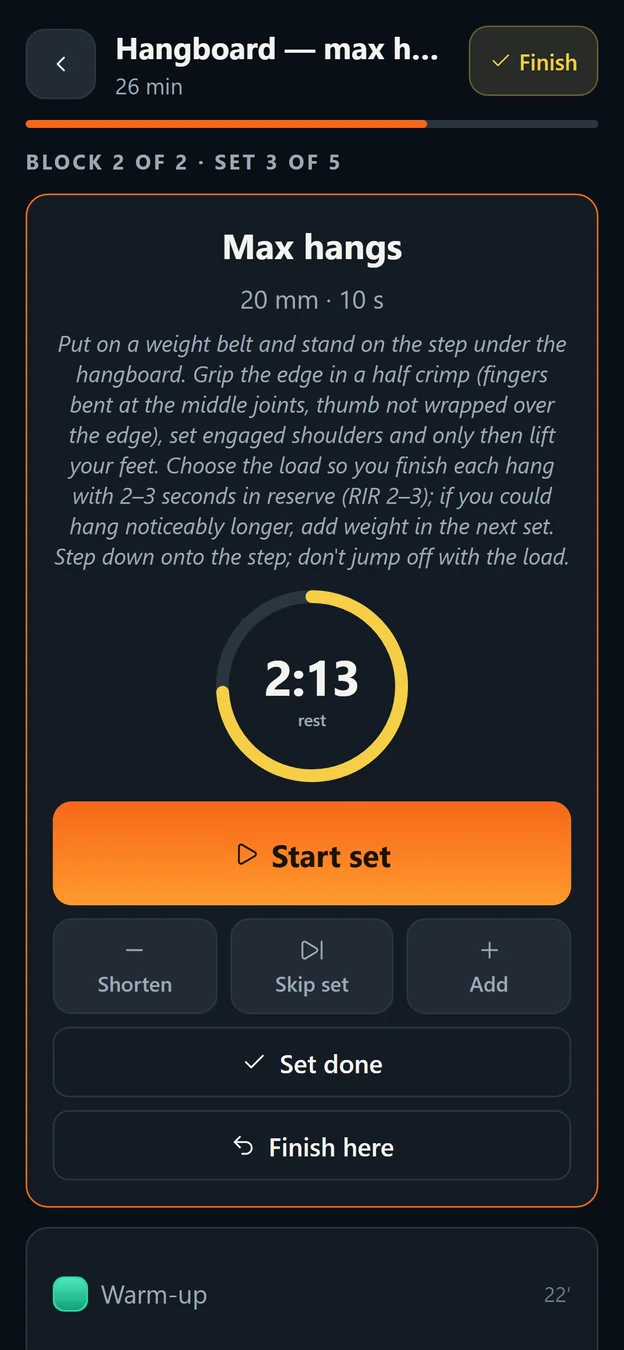
- Sets and reps: 5 hangs of 10 seconds, with 2 minutes of rest between hangs. Start with one set and build to two, with 3 minutes between sets.
- Frequency: once a week, before the climbing and after the warm-up. A second weekly session is for advanced climbers on a full plan, with a rest day between.
- Stop rule: if the grip opens or the shoulders shrug up during a hang, that hang is over and so is the set.
If hanging your body is too much for your shoulders, lift a weight off the floor from an edge instead. It loads the same tissue, and the timings above carry across. No study has compared the two directly.
How to progress. When every hang in both sets feels controlled with that margin intact, take a little less weight off next session. Keep the edge. Keep the grip.
Worth knowing: in an eight-week randomised trial with intermediate to advanced climbers, the group that added a little weight each week improved grip strength more than climbers who kept to normal climbing. The group that trained on smaller and smaller edges did not differ significantly from the climbers who only climbed.
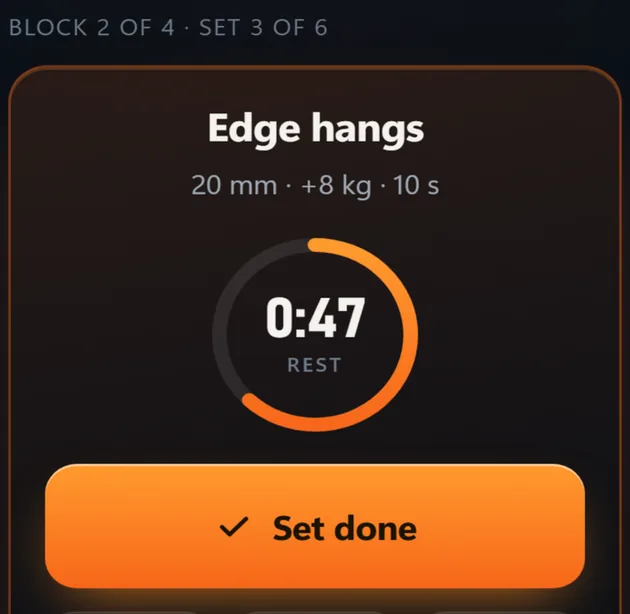
In the app: the hangs, timed and logged. ClimbingDad times each hang and rest, logs the edge and load you used, and suggests the next load from your recent sessions of that exercise. The home screen shows the day’s session. Plans the app builds never put finger days back to back. App-built sessions end with shoulder, elbow and wrist work. Your hangs and climbs also feed readiness on the home screen, which builds up over your first two weeks of logged sessions.
Step 3: measure, then build
A test turns finger strength training into something you can steer. Do it at the start and at the end of a block, after the same warm-up, on the same edge and in the same grip:
- Simple version: the least weight taken off, or the most added, at which you can hold a clean 10-second hang on the 20 mm edge.
- With a crane scale or force sensor: a one-arm pull from the 20 mm edge, best of three attempts with full rest in between.
Worth knowing: a commercial force sensor gave close to the same readings when climbers repeated a one-arm edge pull on a different day, and matched a lab force plate. Standardise the test and a change in the number means more than a change in how a hang feels.
A sample week
An adult climbing three times a week, in a first hangboard block:
- Monday: warm-up, the beginner hangboard routine, then climbing on varied holds.
- Tuesday: rest, or antagonist and shoulder work with no finger load.
- Wednesday: rest.
- Thursday: warm-up, then climbing on varied holds, with no hangboard.
- Friday: rest.
- Saturday: the longest climbing day of the week, indoors or outside, with no hangboard.
- Sunday: rest.
The hangboard comes once a week, on Monday. Finger days never sit back to back here: Monday, Thursday and Saturday each have a day off before the next one. Before you add a hangboard, keep the same three days and climb. When a trip or a hard outdoor weekend comes up, drop the hangboard that week, since the rock already loads your fingers. How a fuller week fits together is in the climbing training plan.
Worth knowing: in a ten-week randomised trial, intermediate and advanced climbers who added two hangboard sessions a week to their usual climbing raised peak finger force on a 23 mm rung by 17%. The control group, who kept climbing as usual, did not change.
Common mistakes
- Starting on a hangboard before you have a climbing base, when the wall would still be the better finger workout.
- Hanging to failure. Stop each hang with a few seconds in hand.
- Changing edge and load in the same block. Then you cannot tell what worked.
- Hard finger days back to back, or the hangboard at the end of a session on tired fingers.
- Copying an advanced protocol because you can get through it. The workouts in hangboard training are for the next stage.
- Skipping the shoulders, elbows and wrists. The joints around the fingers carry the same loads.
- Judging the routine after two weeks. The trials measured change after eight to ten.
Questions climbers ask
How long does it take to improve finger strength?
In controlled trials, intermediate and advanced climbers who added two hangboard sessions a week to normal climbing raised finger strength measurably within eight to ten weeks. Those were study conditions; the beginner routine here starts with one session a week. True beginners were not studied. Give one routine a full block before you judge it, and test the same way at the start and at the end.
Can I build finger strength without a hangboard?
Yes. Climbing itself is finger training, especially bouldering on smaller holds with varied grips. Lifting a weight off the floor from an edge loads the same tissue without hanging your body. A hangboard adds a load, an edge and a time you control, which matters once climbing alone stops moving your fingers on.
How often should a beginner train fingers?
Climbing two or three times a week already loads your fingers. If you add a hangboard, start with one short session a week, and keep hard finger days apart from each other.
Is a hangboard safe for beginners?
It can be, with a light start. Take weight off with your feet or a pulley, stop every hang a few seconds short of failure, keep one edge and one grip, and stop the session at sharp pain, a pop or swelling.
Train and log with a coach
ClimbingDad is a free climbing training app for training on your own or with a coach. A coach can plan your week on real dates, move a session by dragging it to another day, and leave a note on a session, which shows on that day’s card. Coaches see their athletes in a roster with one row per athlete. The coach reads your log, but the coach panel cannot change it; if you train with one, you subscribe to that coach. More on training with a coach.
This page describes finger strength training in general terms. It is not medical advice and does not replace an examination by a doctor or physiotherapist.
What research says
The measured facts on this page come from these four papers. All of them studied climbers who were already intermediate or experienced, so none of them tells you what happens in your first year:
- Finger training on top of climbing. A systematic review and meta-analysis: finger flexor training improved finger strength, rate of force development and forearm endurance more than climbing alone. Stien N, Riiser A, Shaw MP, Saeterbakken AH, Andersen V. “Effects of climbing- and resistance-training on climbing-specific performance: a systematic review and meta-analysis.” Biology of Sport, 2023. 10.5114/biolsport.2023.113295
- Adding weight or shrinking the edge. Eight weeks, 30 climbers: added weight beat normal climbing, smaller edges did not differ significantly. Mundry S, Steinmetz G, Atkinson EJ, Schilling AF, Schöffl VR, Saul D. “Hangboard training in advanced climbers: A randomized controlled trial.” Scientific Reports, 2021. 10.1038/s41598-021-92898-2
- Ten weeks of hangboard training. 35 climbers: peak force on a 23 mm rung up 17%, with no change in the control group. Hermans E, Saeterbakken AH, Vereide V, Nord ISO, Stien N, Andersen V. “The Effects of 10 Weeks Hangboard Training on Climbing Specific Maximal Strength, Explosive Strength, and Finger Endurance.” Frontiers in Sports and Active Living, 2022. 10.3389/fspor.2022.888158
- Measuring with a portable sensor. A commercial force sensor was valid against a force plate and reliable between days. Labott BK, Held S, Wiedenmann T, Rappelt L, Wicker P, Donath L. “Validity and Reliability of a Commercial Force Sensor for the Measurement of Upper Body Strength in Sport Climbing.” Frontiers in Sports and Active Living, 2022. 10.3389/fspor.2022.838358