
How to build a climbing training plan
What the evidence supports, what it does not, and how to build a week around the difference
How to build a climbing training plan
What the evidence supports, what it does not, and how to build a week around the difference
You want a number. How many days a week, how hard each one, how long the block runs. Here is the honest starting position: no climbing study has compared two, three or four sessions a week, and none has tested one phase plan against another.
Twelve strength-training studies exist in the whole sport (Langer, Simon & Wiemeyer, Journal of Strength and Conditioning Research, 2023). So a climbing training plan is mostly borrowed practice, resting on a few things that have been shown. This page keeps the two apart.
What a training plan can honestly be built on
Periodisation — dividing training into phases with different aims — came to climbing from other sports, and came with its problems. Kiely's verdict: its assumptions are “no longer scientifically justifiable”, yet they stay “deeply embedded” in how coaches think (Kiely, International Journal of Sports Physiology and Performance, 2012). That covers every sport; in climbing there is no evidence either way.
What survives is duller and more useful. Across every climbing study Saul collected, time spent training predicts climbing performance better than your height, weight or build does (Saul, Journal of Exercise Science and Fitness, 2019). Nobody has shown which arrangement of that time is best.
None of that is an argument for training without a plan. It is an argument for knowing which parts of yours are evidenced and which are convention. So read everything below as one of two things: something measured, in people we can name, or something coaches do that nobody has tested.
How many days a week should you climb?
What exists is a record of what climbers do. Saul's survey of every climbing training study contains none comparing two, three or four sessions a week. The middle climber in Lattice Training's dataset climbs three to four days a week — V4 averages three, V12 and above four (Lattice Training, 2026). A median of behaviour, not an optimum.
Climbing more often goes with climbing harder: across 365 climbers who reported their own training and grades, the link sat about halfway between none and perfect (r = 0.502). That study looked at climbers once, at a single moment, so it cannot say whether climbing more makes you better or better climbers climb more (Turchetto, 2025).
If you are new, the one thing that changes is the content, not the count: two to three sessions a week, each broad and generalist rather than specialised (Movement Gyms, 2025; Lattice Training, 2026).
How often you climb is a weaker injury lever than advertised: it showed no reliable link to injury in a 2026 climber survey (den Hengst, BMJ Open Sport & Exercise Medicine, 2026).
A fourth session that is deliberately lighter may do more for you than lengthening the sessions you already have (Lattice Training, 2026).
Our judgement: pick the number you will still be doing in three months. Consistency early on predicted who kept going, across 389,481 weight-training app users — not climbers, but the only data there is (Frontiers in Sports and Active Living, 2026).
Nobody has tested a rule for how hard each day should be, either. The nearest finding: athletes go harder than planned on easy days and easier than planned on hard days (Foster et al., South African Journal of Sports Medicine, 2001, via Seiler, 2010).
Put the hard work first
This is the best-evidenced instruction on the page and it costs nothing to follow. In weight training, total reps are greater when an exercise sits at the start of the session, big exercise or small — “regardless of the relative amount of muscle mass involved” (Simão, de Salles, Figueiredo, Dias & Willardson, Sports Medicine, 2012).
It is not only about the session you are in. In the same review, whatever came last in a session gained the least strength over the weeks — increases were “inhibited for the last exercise of a given sequence”.
The American College of Sports Medicine says the same thing in its official 2009 guidance: sequence “higher-intensity before lower-intensity exercises” (Position Stand, Medicine & Science in Sports & Exercise, 2009). They grade that recommendation Evidence Category C — their lowest tier.
The climbing-specific number is blunt. Twenty-eight recreational indoor boulderers climbed until they chose to stop; on the day, their finger-hang endurance had fallen 34.2% — far too big a drop to be chance (p<0.001) — pinch-grip strength 5.8% (p=0.009) and explosive pulling power 4.8% (p=0.010) (Wilczyński, Nowosad, Poniatowski, Gerwann & Zorena, Frontiers in Physiology, 2026).
Be precise about what that means. Your fingers and your pulling give out; you do not. Their memory for where the holds were — visuospatial working memory — improved by 16.4%. Tired is not uniformly worse; it is specifically worse at what hard climbing asks for.
So: warm up, then the hardest thing, then everything else. If finger work and limit bouldering share a session, the fingers go first — inside the session, which is the only ordering anybody has tested.
The kinds of session, and what each is for
The split below is ours, not an official set of categories anyone agreed on. The British Mountaineering Council's guidance notes use general conditioning, strength, strength endurance and endurance; Anderson and Anderson's Rock Climber's Training Manual runs a different sequence again.
Whatever the labels, power endurance belongs on the list. It is the quality redpointing is trained for, and the one a four-way split like ours would otherwise lose.
Hard bouldering
Problems at or near your limit, long rests, low volume. No coach we could read tells you how many attempts to have; they all tell you when to stop. Call it when your output dips (Eric Hörst), stop before quality drops (Lattice), a handful of attempts then three or four clean repeats (the BMC's guidance notes).
Any attempt count you are given anywhere is illustration. The cost of climbing past the point where quality drops is that 34.2% above: a third of your finger-hang endurance, gone for the day.
Volume climbing
Two to four grades below your onsight grade, on route scales. The BMC anchor 4x4s four below onsight; Climb Strong three below; Lattice two below to build your engine, and further still — four or more — for easy recovery mileage.
On the V-scale that two-to-four band is unusable — four below a V4 climber is V0. Our judgement for boulderers: problems you can do first go, repeatedly, without your forearms filling.
The only session counts any source prints come from Climb Strong: roughly eighteen problems, in groups of six to eight. And volume does not train technique by itself — Steve Bechtel of Climb Strong gives skill its own timed slot.
Fingers and pulling strength
How your finger flexors perform — how long you can hang, how much force you make and how fast you make it — separates climbers by level, separates climbing styles, and separates climbers from people who do not climb (Saeterbakken and colleagues, Sports Medicine – Open, 2024). Strong fingers go with hard climbing, which is not the same as causing it.
The distinction is not pedantry, and the trials that have tested it disagree. One produced large finger-strength gains which “did not improve bouldering performance” in advanced and elite boulderers over five weeks (Saeterbakken, Bratland, Andersen & Stien, Frontiers in Physiology, 2024).
A later trial from mostly the same researchers, in 22 advanced climbers, found climbing performance did improve — but in both of its training groups, with no untrained group to compare them against (Andersen et al., Frontiers in Physiology, 2026). The review of strength training in climbing reports positive effects across its outcomes (Langer, Simon & Wiemeyer, Journal of Strength and Conditioning Research, 2023).
These trials run five to ten weeks on eighteen to thirty-one mostly advanced climbers, and not one of them measured a grade. Treat transfer as an open question, not a settled one in either direction.
Hangboarding also came with roughly double the odds of injury, campus boarding with about half (odds ratios 1.98 and 0.49) — almost certainly because the climbers who campus board are not like the ones who do not, rather than because campusing protects you (den Hengst, 2026). Protocols are in the hangboard guide.
Endurance and power endurance
ARC-style work is two bouts of 20–35 minutes of continuous easy climbing (Anderson & Anderson, Rock Climber's Training Manual); Lattice put the same work into one uninterrupted stretch of 20–45 minutes.
Power endurance — repeated hard moves on short recovery — is the separate quality. Whether bouldering or routes builds it better is unsettled: no study has compared them, and Bechtel argues bouldering can do it.
On maintenance, coaches say weekly (Hörst). Research on what you lose when you stop suggests a session every two weeks holds 90–95% of what you built — but that was untrained young women on leg press and a bike, in a trial indexed only by number (PMC11280775).
Spacing the hard days
The received wisdom says hard finger days need wide spacing. The flagship hangboard trial in this sport did the opposite, and worked.
Advanced sport climbers, 7c+/8a on average, did maximal dead hangs twice a week: Mondays and Wednesdays, 48 hours apart. That sat inside a six-day training week, and over the eight weeks their grip endurance rose 34–45% (López-Rivera & González-Badillo, Journal of Human Kinetics, 2019). Twelve climbers left, for illness and commitments, not finger injuries.
Two other trials ran finger work on a similar schedule without trouble (Dindorf et al., Sensors, 2024; Saeterbakken et al., 2024), both in experienced climbers.
That is a demonstration, not permission: 48 hours worked for that population. No study charts how finger strength recovers over the 24 to 72 hours after hard climbing.
One thing about the easy day is demonstrated: it does not recover your forearms. “Using the same muscle group for active recovery should be avoided” (Krupková, Tufano & Baláš, 2024). That was measured inside one session, in 22-minute rest windows; stretching it across a whole day is us guessing past the evidence.
The reasons to vary the week anyway are thin. In 25 athletes watched across a season, illness rose in the weeks when training was heavier, more samey, or both (Foster, Medicine & Science in Sports & Exercise, 1998) — illness, not injury.
The best evidence for keeping easy days easy comes from horses, who started breaking down within five days when their easy days were made harder (Bruin, Kuipers, Keizer et al., 1994).
If you space days to avoid injury, you are pulling the wrong lever. The evidenced risks are intensity, bouldering, low finger strength, crimping and previous injury — not volume (Quarmby et al., 2023).
Blocks are shorter than you have been told
Six to eight weeks is the number everyone repeats, and it comes from no study. Across the training studies, blocks run one to six weeks, most often two to four (Mølmen, Øfsteng & Rønnestad, Open Access Journal of Sports Medicine, 2019). Six to eight is a scheduling compromise.
Short blocks are not too short to change anything. Four weeks of hangboarding clearly raised grip strength (p<0.001), and raised how fast elite climbers could pull hard — their rate of force development — by 27–32% (Medernach, Kleinöder & Lötzerich, Journal of Strength and Conditioning Research, 2015; Levernier & Laffaye, 2019).
Nor do long blocks reliably end in fatigue — though what was measured is the length of the whole programme, not of one block inside it.
Pooling many weight-training trials, longer programmes came with bigger gains in the heaviest single lift (β=0.03, p=0.0067), and programmes that mixed hard and easy work throughout rather than holding one focus for a block — undulating ones — came out ahead (β=0.51, p=0.0010). The authors call the block rationale “speculated”, and the least experienced gained most from having a plan at all — but the plan that won was the mixed one (Williams, Tolusso, Fedewa & Esco, Sports Medicine, 2017).
One focus per block is block periodisation's founding argument and it has never been tested. No study has checked whether the gains arrive when the model says they do (Issurin, 2008; Afonso et al., Frontiers in Physiology, 2019).
If you are running a block for your tendons, there is no schedule to give you. No tendon study has run shorter than eight weeks, the ones at twelve weeks and over did somewhat better, and nobody has studied finger tendons at all (Bohm, Mersmann & Arampatzis, Sports Medicine – Open, 2015).
Deload weeks
What lifters actually do is documented. Surveyed lifters training for strength or for looks take 6.4 ± 1.7 days off — most took five to eight — every 5.6 ± 2.3 weeks, cutting volume through sets and reps while leaving training frequency unchanged (Rogerson, Nolan, Androulakis Korakakis, Immonen, Wolf & Bell, Sports Medicine – Open, 2024). A longer cycle than the blocks above, in a different sport.
None of that describes climbers.
Whether you need one is genuinely open, and practitioners split on it. Hardly anyone has studied it, and the studies that exist do not agree on what counts as a deload — the research is “underrepresented”, with a “lack of operational definition” (Bell et al., Frontiers in Sports and Active Living, 2022). The one randomised trial found a deload week hurt lower-body strength (Coleman et al., PeerJ, 2024).
The axis of the disagreement is what you think fatigue is. If it masks fitness you have already built, a lighter week reveals it. If it is simply the absence of training, a lighter week costs you a week.
Two example weeks
These are illustrations, not prescriptions. Nothing in the evidence supports any particular ordering of days — the two session-order findings above are both about the order of work inside one session.
What these weeks do is apply the three things this page stands on: hard work first, an easy climbing day is not forearm recovery, and a frequency you will still be doing in three months — the first two demonstrated, the third our judgement. Move the days to suit your life.
A three-day climbing week
- Day one — finger work first, then limit bouldering. Hardest thing first, inside the session (Simão et al., 2012).
- Day two — volume climbing, two to four grades below onsight. Not a recovery day for your forearms; it is its own session (Krupková et al., 2024).
- Day three — a long day: projecting, routes, or rock.
The 48 hours between the first two days is copied from López-Rivera's protocol, where it worked in advanced sport climbers over eight weeks — inside a six-day week, not a three-day one. It is a precedent, not a rule, and nothing in the evidence forbids the days sitting closer together.
A bouldering-only training plan
- Day one — limit bouldering. Stop when the quality of your attempts drops.
- Day two — volume: around eighteen problems, in groups of six to eight (Climb Strong), picked so you can repeat them cleanly.
- Day three — projecting, plus pulling work and pushing work for the other side of the shoulder.
Add finger training on top and expect it to raise your finger strength, not necessarily your bouldering — one trial that tested that combination found exactly that (Saeterbakken et al., 2024), though a later one found climbing performance improved in both its training groups (Andersen et al., 2026).
How ClimbingDad fits in
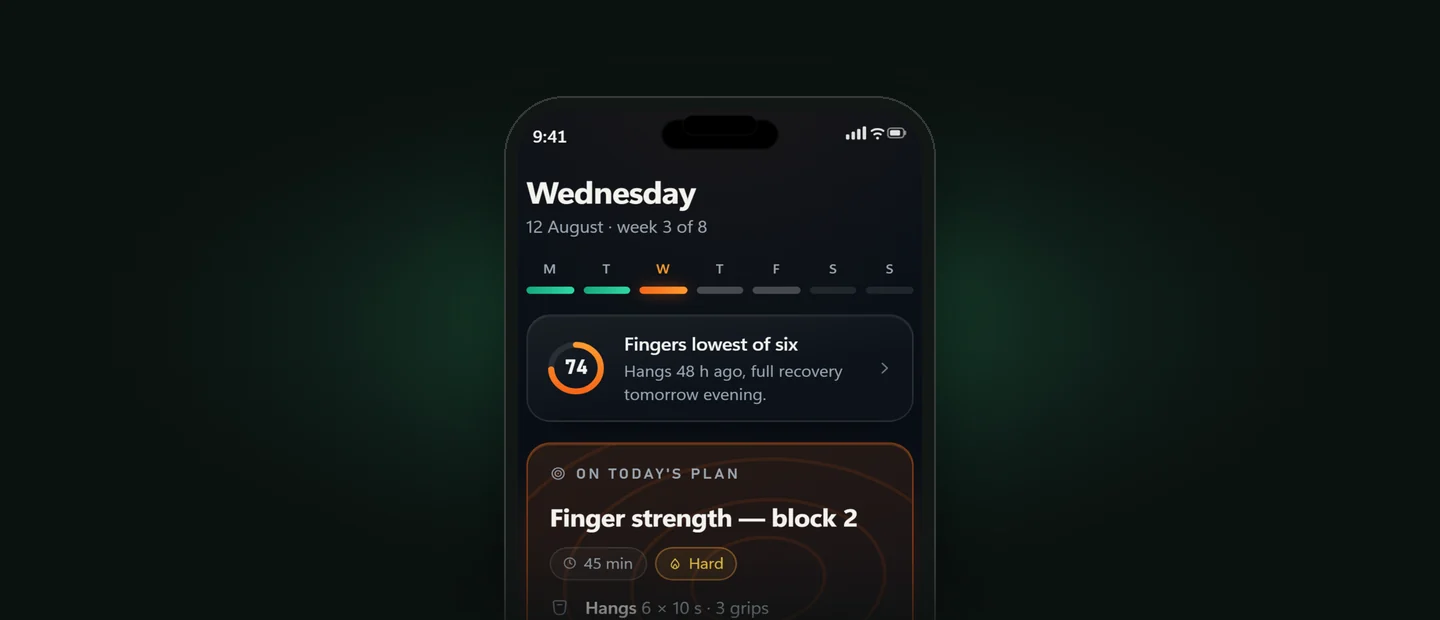
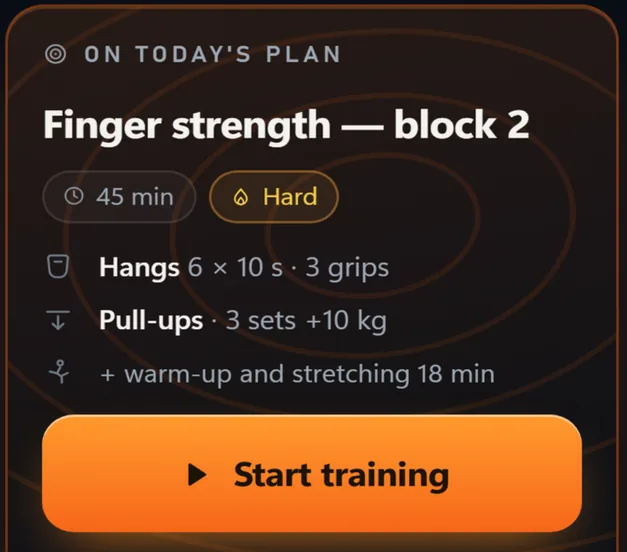
ClimbingDad puts one session on your home screen, decided in advance, and shows the week as a session title and status per day. You log sets and loads as you go, on a rest timer that starts when you tick a set. A readiness score across six systems tells you what it sees; it never blocks a session. The app is free; with a coach, you subscribe to the coach.
Questions climbers ask
How many days a week should I climb?
No study has compared two, three or four sessions a week in climbers, so there is no optimum. The middle climber in Lattice Training's 2026 dataset trains three to four days. Climbers who trained more often climbed harder grades in survey data (Turchetto, 2025), but that design cannot show which way the arrow points.
What is a deload week, and do I need one?
Surveyed lifters take about a week off every five or six weeks (6.4 ± 1.7 days every 5.6 ± 2.3 weeks), cutting sets and reps and keeping frequency unchanged (Rogerson et al., 2024). Whether you need one is unsettled — the one randomised trial found a deload week hurt lower-body strength (Coleman et al., 2024). No climbing study has looked.
How long should a training block be?
Shorter than six to eight weeks, on what the training studies actually use. Blocks in them run one to six weeks, most often two to four (Mølmen et al., 2019), and four weeks of hangboarding clearly raised grip strength and rate of force development in elite climbers (Medernach et al., 2015; Levernier & Laffaye, 2019).
What should I do when I miss a session?
Carry on with the week as written. No study has tested a single missed session, so this is reasoning past the evidence: if you stop completely for under four weeks, the strength you lose is described as modest (Mujika & Padilla, 2000). Doubling up to catch up is often said to cost you a fortnight. The risk-factor evidence does not support that.
Should I train bouldering or routes?
Train what you want to be good at. The tidy story — bouldering builds strength, routes build endurance — has no study behind it either way, and Steve Bechtel argues endurance can be built by bouldering. Finger strength separates climbers by level (Saeterbakken and colleagues, Sports Medicine – Open, 2024), but the trials that trained it disagree: one found no improvement in bouldering (Saeterbakken et al., 2024), a later one found climbing performance improved in both its training groups, with no untrained group to compare against (Andersen et al., 2026).