
Training guide · Getting better
How to get better at climbing: technique first, then strength, plateaus and rest
Footwork, body position, reading routes and falling first, then when strength starts to matter, what to do on a plateau, and why rest counts


Build your training yourself or with a coach.
In short
- Technique first. Quiet, precise feet and a good body position save more strength than most training adds in your first years.
- Climb more, and climb different things: other walls, angles, hold types and styles.
- Read the route and practice falling. Fear and guesswork cost moves that your arms could do.
- Strength matters once fingers are what stops you. Then add finger work, one change at a time.
- On a plateau, change one thing for a block, and rest enough that hard days stay hard.
Getting better at climbing comes from three things, in this order: moving better, climbing more and more varied terrain, and later, training the specific strength your climbing asks for. This page is the broad start. It gives climbing tips for beginners and for climbers who have stalled, and sends you to the detailed guides when you need them. Once you climb regularly and want structure, building a climbing training week is the next step. The drills and doses below are common coaching practice, marked as such. Measured facts from studies are in the science section, with sources at the end.
Climbing tips for beginners: start with your feet
Most beginners pull with their arms and let their feet find the wall on their own. Good climbers push with their legs and use their arms to stay on. Every move your feet do well is strength your fingers keep for later.
- Look at the foothold until your foot is on it. Then look for the next handhold.
- Silent feet. On easy climbs, place each foot so it makes no sound. A quiet foot is a precise one.
- Use the tip of the shoe. Stand on the inside edge of the big toe on small holds, so you can turn and pivot.
- Trust the feet. Press down through the foothold and stand up on it, rather than hanging from your hands.
- Drill it in the warm-up. A few easy climbs with silent feet fit into any climbing warm-up.
Body position: hips, straight arms, turning in
- Straight arms when you rest or reach. Hang from your skeleton and bend your arms only to make a move.
- Hips close to the wall on vertical and slab terrain, so your weight goes into your feet.
- Turn in on steep ground. Put the hip on the side of your reaching hand against the wall and drop the knee in. You reach further with less pull.
- Move from your legs. Start each move by standing up or rotating, then reach.
- Rest on the route. Shake out on good holds with straight arms before the hard section, not after it.
Read the route before you climb
Before you start, stand back and look for the holds you will use, which hand goes where, where the feet go and where you can rest. Mime the sequence with your hands. On a boulder, plan the first three or four moves at least.
Worth knowing: in a study of 29 male climbers, a 3-minute route preview led to fewer and shorter stops on the route. It did not change how many climbers reached the top. Reading a route makes your climbing smoother. It does not replace the strength to do the moves.
Practice falling
Fear of falling makes climbers grip harder, stop more often and climb more stiffly. On a lead route, many climbers fail on moves they could do on top rope.
- Bouldering: learn to land on both feet with your knees bent and roll back onto the mat. Keep your arms in instead of reaching out to catch yourself. Start with jumps off from low down.
- Lead climbing: start with small falls on steep, clean terrain, with a belayer who knows how to give a soft catch. Make the falls a little longer over several sessions.
- Make it routine. A few planned falls at the start of a session make the unplanned ones less of a shock.
- Learn from someone qualified. Falling practice on rope needs supervision until you and your belayer have done it many times.
Worth knowing: in a study of novice climbers, the same traverse set high on the wall raised anxiety, heart rate, blood lactate and forearm fatigue compared with the low version, and made climbing slower and less fluent. Fear cost energy on moves that were identical.
Climb more, and climb different things
For most climbers in their first years, more climbing on more kinds of terrain is the biggest lever. Variety teaches movements that one wall cannot.
- Two or three sessions a week, with at least one day off between the hard ones. Regular sessions beat occasional long ones.
- Change the angle: slab, vertical and overhang in the same week.
- Change the holds: crimps, slopers, pinches and pockets, so no one grip does all the work.
- Change the wall now and then, and climb outdoors when you can. A new setter’s style finds your gaps.
- Repeat climbs you almost did. Many problems near your limit teach more than one project you are nowhere near.
- Climb your weakest style on purpose for part of every session.
How to get better at bouldering
Everything above applies, with a few additions. Hard bouldering loads fingers and shoulders in a few moves, so warm up fully before it.
- Session shape: warm-up, then the hardest problems while you are fresh, then volume on easier ones.
- Rest between attempts. Three to five minutes between hard tries is common. Tired attempts teach bad habits.
- Work moves, not only whole problems. Pull on at the crux, do it, step off.
- Stop when your attempts get worse, not when you run out of time.
- Boards come later. A standard board training setup gives the same problems every week, which helps you see progress. The campus board is for experienced climbers whose fingers are already trained.
When strength starts to matter
In the first year or so, the wall does most of the strength work. Strength starts to decide your grade when your feet, body position and nerves hold up and you still come off because a hold is too small. Then:
- Fingers first. Finger strength is the most climbing-specific strength there is. Start in finger strength for climbing, and move to hangboard training when you have a base.
- Pulling and the muscles around the joints. Pull-ups, rows, pushing and shoulder work are in exercises for climbers, and what the research says about the gym is in strength training for climbers.
- One new thing at a time. Add finger work, keep climbing as before, and judge it after several weeks.
- Climbing stays most of your week. Extra training adds to climbing and does not replace it.
Climbing plateau: what to change when progress stops
A plateau usually means the same sessions on the same wall for months. Find the reason before you change the sessions.
- Write down where you fall. For two or three weeks, note what stopped you on each hard climb: feet, a hold too small, pump, fear, the wrong sequence.
- Match the fix to the reason. Feet and sequence mean technique and variety. Small holds mean finger work. Pump means more climbing on easier ground for longer. Fear means falling practice.
- Change one thing for a block of about four weeks, then judge it. Several changes at once leave you not knowing which one worked.
- Check that hard days are hard and easy days are easy. When every session is medium, nothing gets better.
- Check your rest before you add training. A tired climber on a plateau needs less, not more.
Rest is part of getting better
Climbing hard on tired fingers is how pulley injuries start, and a few weeks off injured costs more than a few rest days. A common coaching approach is at least one day between hard sessions, and an easier week after a few hard ones. If your fingers still ache the next morning, make the next session easy or take the day off. Keep finger-heavy days apart, and stop at sharp pain. How fatigue builds up per body part is explained in readiness.
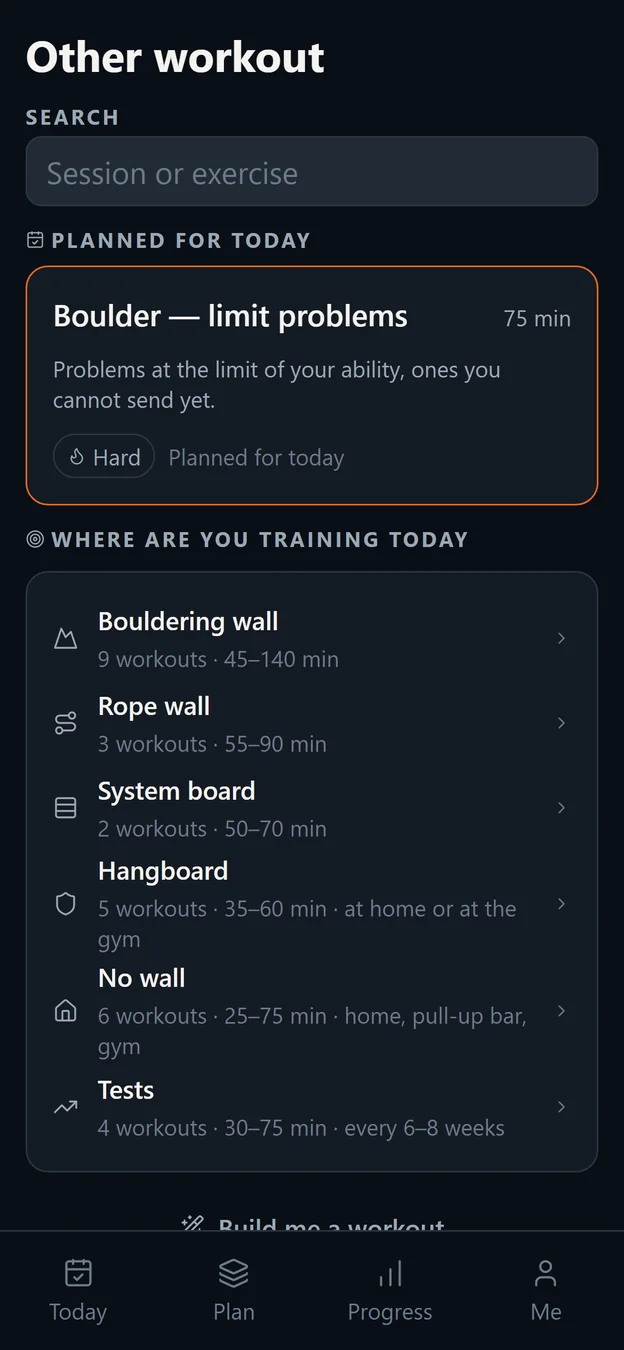
In the app: ClimbingDad logs every climb with a grade and a result: flash, onsight, redpoint, top, fall or attempt. That gives you the record a plateau needs, so you can see what you actually climbed instead of what you remember. The workout picker groups workouts by where you train, from the bouldering wall and rope wall to the system board, the hangboard and no wall, or you can search by session or exercise. From what you log, the app tracks fatigue in six areas: fingers, forearm endurance, pulling, pushing, the nervous system and aerobic fitness. It informs and never blocks a session, and a plan the app builds never puts two finger days back to back.
Common mistakes
- Training strength before technique. Weak feet waste whatever strength you add.
- Always climbing the same wall, angle and style.
- Projecting one problem for weeks instead of climbing many near your level.
- Avoiding falls and then failing on moves you could do on top rope.
- Starting on the campus board too early. It is for trained fingers.
- Changing everything at once after a bad month.
- Treating every session as a hard one, with no easy days and no rest days.
- Climbing through finger pain. Pain ends the session.
What predicts climbing performance
Trainable factors count far more than build. A study of 41 climbers, 15 novice, 16 skilled and 10 elite, found that trainable variables explained 46% of the differences in climbing ability, while anthropometry and muscle characteristics explained under 4%. Climbing ability was more closely related to climbing-specific strength than to general strength.
Strength, endurance and movement. A systematic review found that successful climbers had strong, well-trained forearms and good aerobic capacity, and that grip strength and endurance, postural stability and refined movement were beneficial. A later review of 74 studies on sport climbing named cardiorespiratory endurance and muscular strength, endurance and power as the determinants of performance. Balance, flexibility and body measurements appeared to matter less, and the evidence on body measurements conflicted.
Reading a route changes how you climb. In 29 male climbers of intermediate to expert level, a 3-minute preview led to fewer and shorter stops. It did not change whether they finished the route.
Fear costs energy. In two experiments with 13 and 17 novice climbers, the same traverse set high on the wall instead of low raised anxiety, heart rate, blood lactate and muscle fatigue, and made climbing slower and less fluent.
Specific strength work can move bouldering. In 16 advanced and elite climbers, five weeks of campus board training twice a week improved bouldering performance compared with a group that kept its normal climbing. Those climbers were already highly trained, so this tells you nothing about the campus board in your first years.
Questions climbers ask
What is the fastest way to get better at climbing?
Climb more often, on more kinds of wall, and pay attention to your feet on every climb. In a study of 41 novice, skilled and elite climbers, trainable factors explained 46% of the differences in climbing ability, while build and muscle characteristics explained under 4%.
How do I get better at bouldering?
Climb many different problems near your level, repeat the ones you almost did, and look at each problem before you start. Learn to fall onto your feet. Board climbing and finger work come later, once technique and regular climbing are in place.
When should a beginner start training fingers?
No study sets the exact point. A common coaching threshold is around a year of regular climbing, once you fall off because you cannot hold the hold rather than because of your feet or nerves, and your fingers feel normal the morning after a hard session.
Why have I stopped improving at climbing?
Usually because the sessions stopped changing: the same wall, the same style, the same grade. Find what you fall off, change one thing for four weeks, and judge it after the block. If you feel tired all the time, rest more before you train more.
How many rest days do climbers need?
No study gives a number for climbers. A common coaching approach is two or three sessions a week with at least one day off between the hard ones. If your fingers still ache the next morning, the next session should be easy or a rest day.
Train and log with a coach
ClimbingDad is a free climbing training app for training on your own or with a coach. A coach can plan your week and leave a note on a session, which shows on that day’s card. The coach reads your log, but the coach panel cannot change it; if you train with one, you subscribe to that coach. More on training with a coach.
About the author. Mateusz Kuba is a sport climbing instructor (instruktor sportu, sport climbing) with C4PC Level 1 — Strength Training for Youths. He coaches climbers on climbing walls in Warsaw and built ClimbingDad.
This page describes climbing and training in general terms. It is not medical advice and does not replace an examination by a doctor or physiotherapist.
What research says
The measured facts on this page come from these six papers. None of them tested a technique drill or a falling program directly, so the advice on footwork, body position and falling is coaching practice:
- Trainable factors and climbing ability. 41 climbers; trainable variables explained 46% of the variance in climbing ability, anthropometry and muscle characteristics under 4%. Laffaye G, Levernier G, Collin JM. “Determinant factors in climbing ability: Influence of strength, anthropometry, and neuromuscular fatigue.” Scandinavian Journal of Medicine & Science in Sports, 2016. 10.1111/sms.12558 (PMID 26453999)
- Determinants of success. Forearm strength and endurance, aerobic capacity, postural stability and refined movement were beneficial. Saul D, Steinmetz G, Lehmann W, Schilling AF. “Determinants for success in climbing: A systematic review.” Journal of Exercise Science & Fitness, 2019. 10.1016/j.jesf.2019.04.002 (PMID 31193395)
- Sport climbing performance. 74 studies; cardiorespiratory endurance and muscular strength, endurance and power determine performance, balance, flexibility and anthropometry less. Faggian S, Borasio N, Vecchiato M, Gatterer H, Burtscher M, Battista F, et al. “Sport climbing performance determinants and functional testing methods: A systematic review.” Journal of Sport and Health Science, 2025. 10.1016/j.jshs.2024.100974 (PMID 39216626)
- Route preview. 29 male climbers; a 3-minute preview gave fewer and shorter stops, with no change in route completion. Sanchez X, Lambert P, Jones G, Llewellyn DJ. “Efficacy of pre-ascent climbing route visual inspection in indoor sport climbing.” Scandinavian Journal of Medicine & Science in Sports, 2012. 10.1111/j.1600-0838.2010.01151.x (PMID 20561271)
- Anxiety and movement. 13 and 17 novice climbers; a high traverse raised anxiety, heart rate, lactate and fatigue, and made climbing slower and less fluent. Pijpers JR, Oudejans RRD, Holsheimer F, Bakker FC. “Anxiety-performance relationships in climbing: a process-oriented approach.” Psychology of Sport and Exercise, 2003. 10.1016/S1469-0292(02)00010-9
- Campus board and bouldering. 16 advanced and elite climbers; five weeks of campus board training twice a week improved bouldering performance against a control group. Stien N, Pedersen H, Vereide VA, Saeterbakken AH, Hermans E, Kalland J, Schoenfeld BJ, Andersen V. “Effects of Two vs. Four Weekly Campus Board Training Sessions on Bouldering Performance and Climbing-Specific Tests in Advanced and Elite Climbers.” Journal of Sports Science and Medicine, 2021. 10.52082/jssm.2021.438 (PMID 34267583)