Training guide · Injury
A2 Pulley Injury in Climbers: Symptoms, Grades and Prevention
What it feels like, how it is graded, and a warm-up, grip choice and training week that spare your pulleys


Build your training yourself or with a coach.
In short:
- The A2 pulley holds the finger flexor tendons against the bone near the base of the finger. Hard crimping loads it most.
- Typical signs are pain and swelling at the base of the finger, sometimes a pop. Pain means a specialist, not a test hang.
- Grades I to IV run from a strain to several torn pulleys. The specialist sets the grade and decides on treatment and return.
- What you control: a finger warm-up in sets, open hand or half crimp as your default, one change at a time, and no two hard finger days in a row.
This page is written by a sport climbing instructor who is not a physiotherapist or a doctor, so the medical questions here go to a specialist and the training questions stay with you and your coach.
If something popped in your finger
- Stop the session. Do not finish the boulder or the set.
- Do not test the finger on a hold or the hangboard.
- Write down the hold, the grip, the move, and whether you felt or heard a pop. The specialist will ask.
- See a physiotherapist or doctor, ideally one who works with climbers. Ultrasound is the usual first imaging test, with MRI when it is unclear.
- Leave the return to the specialist. Timelines, taping and the first sessions back depend on the grade and on your finger.
What the A2 pulley is and why crimping loads it
Your finger flexor tendons run along the palm side of each finger. Pulleys, rings of fibrous tissue, hold them close to the bone so the finger bends instead of the tendon lifting away. A2 sits near the base of the finger, and with A3 and A4 it is most at risk in climbers, especially when the load arrives suddenly, for example when a foot cuts on a small hold.
In a full crimp the middle finger joint bends to about 90 degrees and the fingertip joint bends backwards, so the tendons press outward against the pulleys. Worth knowing: in a cadaver study from Erlangen, the force on the A2 pulley in a crimp was more than twice the force in an open hand, while the force at the fingertip did not differ significantly. Same hold, very different job for the pulley.
A2 pulley injury symptoms
Climbers with a pulley injury usually report pain on the palm side at the base of the finger, swelling in the same place, and sometimes a pop at the moment of injury, often on a hard crimp. Visible bowstringing, the tendon lifting away from the bone, usually needs more than one torn pulley. So a finger that looks normal can still be injured.
A2 pulley injury grades
Climbing medicine usually uses four grades, described by Volker Schöffl’s group:
- Grade I: a pulley strain.
- Grade II: a partial rupture.
- Grade III: a complete rupture of one pulley.
- Grade IV: several ruptured pulleys.
The specialist sets the grade after imaging, and the grade decides the treatment: grades I to III usually without surgery, grade IV usually with surgical repair. Most climbers return to their previous level. How long that takes is for the specialist who examined your finger, so this page gives no timelines.
Prevention protocol: warm up your fingers in sets
A common format before a session on small holds or the hangboard. The numbers are typical ranges from general training practice, not a rule from a study:
- 5 to 10 minutes of easy movement, such as traversing or light cardio.
- 3 to 5 easy climbs on big holds, well below your limit, a minute or two between them.
- 3 to 4 climbs on smaller holds, stepping the hold size down, 2 to 3 minutes between climbs.
- On the hangboard, if today uses it: 2 to 3 sets of 3 to 5 hangs of 7 to 10 seconds with your feet taking part of the weight, raising the effort set by set, 1 to 2 minutes between sets.
- Only then limit attempts, board climbing or working hangboard sets.
The whole session warm-up, with 10- and 20-minute routines and versions for bouldering and the hangboard, is in the climbing warm-up guide.
Worth knowing: when Andreas Schweizer measured climbers’ fingers, the natural gap between tendon and bone at the A2 pulley grew by about 30% during a warm-up. A 2021 review reads this as one reason a proper warm-up is thought to help prevent pulley injuries.
Grip choice: open hand and half crimp first
On the hangboard, make the open hand or half crimp your default and train the full crimp sparingly, if at all. On the wall you will still crimp, so choose where: open hand where the hold allows it, a crimp where the hold needs it, fewer hard crimps when you are tired. The open hand is not risk-free either: the same cadaver study found similar tendon forces in both grips. The aim is to spread the load, not to stop crimping.
Load progression: one change at a time
A 2024 review of resistance training in climbing describes injury prevention as building tolerance to the loads climbing demands, and recommends limiting fingerboard and campus board training in lower-graded climbers. Coaching rules that follow from this include raising one variable at a time (load, edge size or volume) and giving the fingers rest between hard finger sessions.
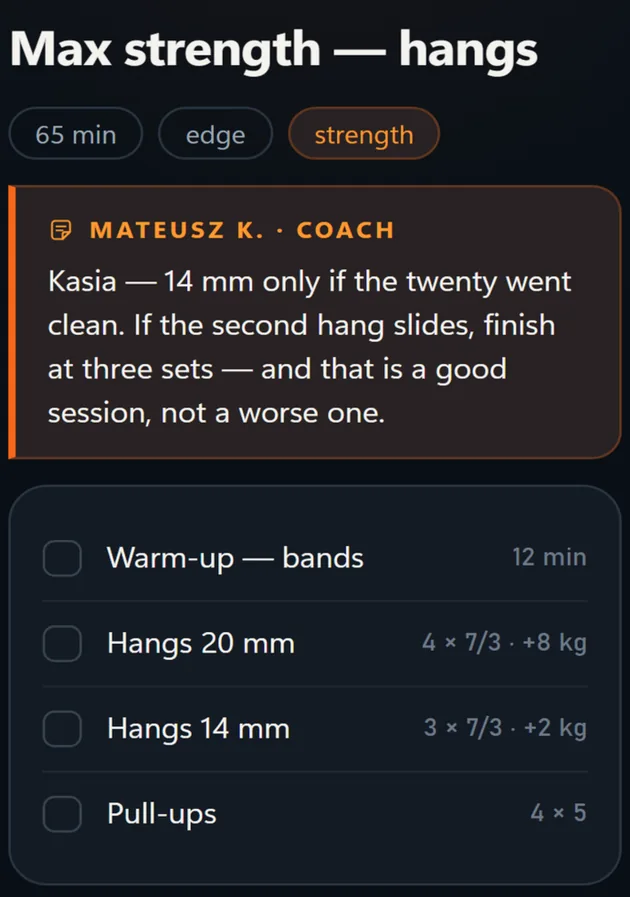
- One variable per step: keep the 20 mm edge and add load, or keep the load and move to a smaller edge, never both in one block.
- Small steps: a typical step is 1 to 2 kg or one more set, only after every hang of the last session felt controlled.
- Stop before failure: end each max hang before your grip starts to change.
More in hangboard training, strength training for climbers and the climbing training plan.
A training week that spares your pulleys
A hard finger day is anything on small holds near your limit: board climbing, hard bouldering or max hangs. Start with one hard finger day a week; two is the upper limit, with a full day between them. An example with three climbing days:
- Monday, hard: finger warm-up, then max hangs or limit bouldering, then easier volume.
- Tuesday: rest, or antagonist and core work with no finger load.
- Wednesday, easy: big holds, technique and footwork.
- Friday, hard: the same warm-up, then hard climbing.
- Weekend: one easy session or rest. A hard day outdoors replaces Friday.
With two climbing days, make one hard and one easy. In your first year of climbing, leave the hangboard out and let climbing load your fingers.
Common mistakes
- Going straight to limit moves on cold fingers.
- Testing a finger after a pop “to see how it feels”.
- Changing load and edge in one block, so you cannot tell which change hurt.
- Stacking hard finger days, such as a board session the day after limit bouldering.
- Climbing through sharp, point-specific pain. That ends the session.
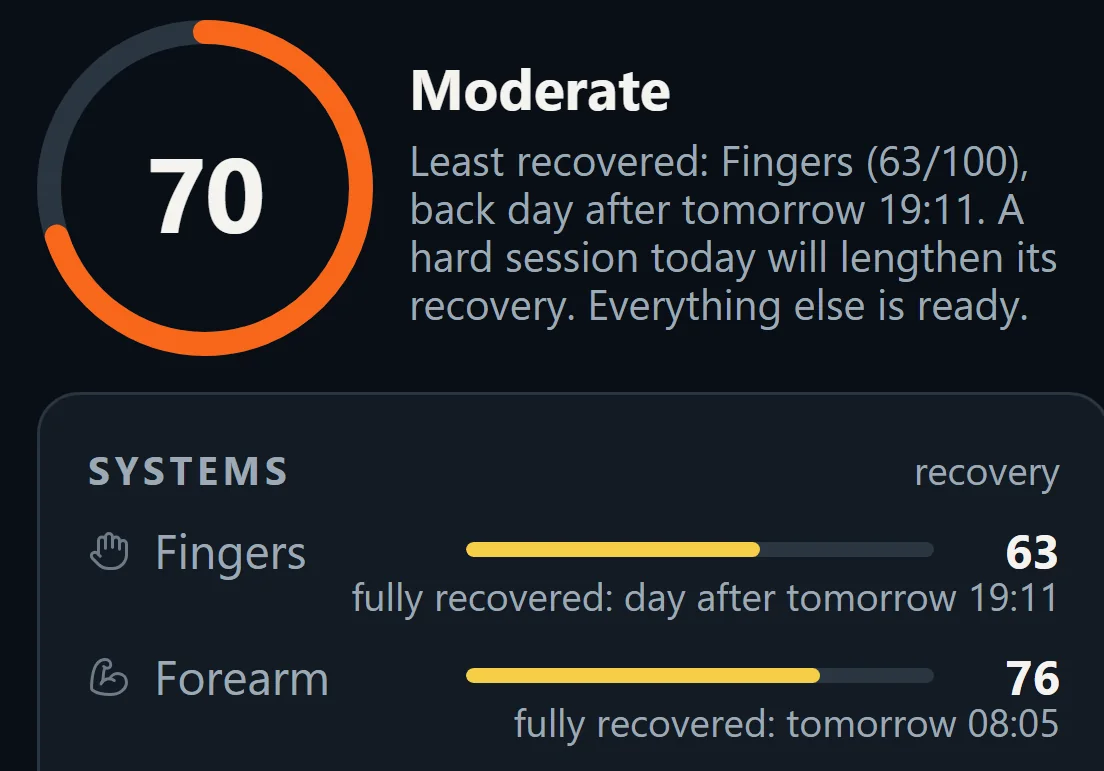
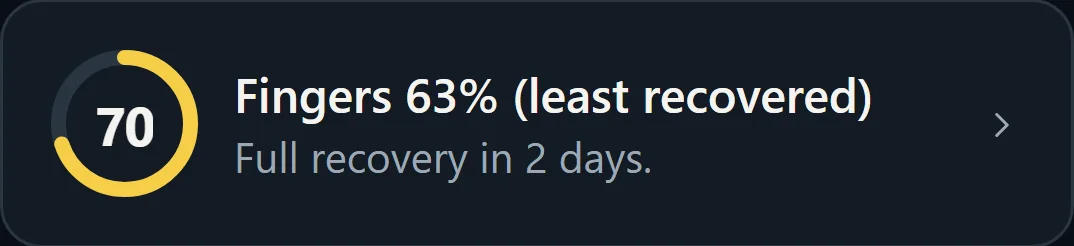
In the app: log the one change. ClimbingDad logs each hangboard set with sets, reps, hold time, rest, added load in kg and edge size in mm, and runs the hangs with an interval timer, so the log shows which variable you raised. After about two weeks of logged sessions, it shows fatigue for your fingers, forearms and four other systems. How finger fatigue is calculated. It informs and never blocks a session, and it does not assess injuries.
Questions climbers ask
What is a pulley injury?
A strain or tear of one of the fibrous rings, called pulleys, that hold the finger flexor tendons against the bones. In climbers it is most often caused by hard crimping on small holds.
What does a pulley injury feel like?
Climbers commonly report pain and swelling at the base of the finger, sometimes with a pop felt or heard at the moment of injury. Only a clinical exam and imaging can confirm it.
How long does a pulley injury take to heal?
It depends on the grade, which a specialist sets after imaging. Grades I to III are usually treated without surgery, and most climbers return to their previous level. Ask the specialist treating you for your timeline.
What is pulley bowstringing?
The flexor tendon lifting away from the bone as you bend the finger. Visible bowstringing usually means more than one torn pulley and needs a specialist exam.
How can I avoid a pulley injury?
No routine removes the risk. Warm up your fingers in sets, use an open hand or half crimp as your default on the hangboard, raise one variable at a time, and keep a full day between hard finger sessions.
Train and log with a coach
ClimbingDad is a free climbing training app for training on your own or with a coach. When a specialist and a coach set a gradual return, you log every session, and the coach panel can read your log but cannot change it. More on training with a coach. The app works offline, in English and Polish.
About the author. Mateusz Kuba is a sport climbing instructor (instruktor sportu, sport climbing) with C4PC Level 1 — Strength Training for Youths. He coaches climbers on climbing walls in Warsaw and built ClimbingDad.
This page describes pulley injuries in general terms, based on the research below. It is not medical advice, does not replace an examination by a doctor or physiotherapist, and gives no treatment or return-to-climbing plan.
What research says
The medical facts on this page come from these six papers:
- Most common overuse injury. Crimping is the mechanism, ultrasound is the first imaging test, and a proper warm-up is thought to help prevent pulley injuries. Miro PH, vanSonnenberg E, Sabb DM, Schöffl V. “Finger Flexor Pulley Injuries in Rock Climbers.” Wilderness & Environmental Medicine, 2021. 10.1016/j.wem.2021.01.011
- Signs and outcome. Pain, swelling and a pop are typical; visible bowstringing needs several torn pulleys; most climbers return to their previous level. King EA, Lien JR. “Flexor Tendon Pulley Injuries in Rock Climbers.” Hand Clinics, 2017. 10.1016/j.hcl.2016.08.006
- Grades I to IV. Grades I to III are treated conservatively, grade IV needs surgery. Schöffl VR, Schöffl I. “Injuries to the finger flexor pulley system in rock climbers: current concepts.” Journal of Hand Surgery (American Volume), 2006. 10.1016/j.jhsa.2006.02.011
- Crimp vs open hand. In cadaver fingers, the A2 pulley carried more than twice the force in a crimp. Schöffl I, Oppelt K, Jüngert J, Schweizer A, Neuhuber W, Schöffl V. “The influence of the crimp and slope grip position on the finger pulley system.” Journal of Biomechanics, 2009. 10.1016/j.jbiomech.2009.04.049
- Warm-up. Bowstringing at the A2 pulley grew by about 30% during a warm-up. Schweizer A. “Biomechanical properties of the crimp grip position in rock climbers.” Journal of Biomechanics, 2001. 10.1016/s0021-9290(00)00184-6
- Load tolerance. Build tolerance to climbing loads; limit fingerboard and campus board work in lower-graded climbers. Saeterbakken AH, Stien N, Pedersen H, Langer K, Scott S, et al. “The Connection Between Resistance Training, Climbing Performance, and Injury Prevention.” Sports Medicine – Open, 2024. 10.1186/s40798-024-00677-w