
Training guide · Exercises
Exercises for Climbers: Fingers, Pulling, Antagonists, Core and Mobility
Sets, reps and rest for each exercise, a sample week, and the mistakes to skip


Build your training yourself or with a coach.
In short:
- Climbing comes first. In your first year or so, climbing plus bodyweight exercises do more than a hangboard or campus board.
- Pick one or two exercises per group: fingers, pulling, antagonists, core, legs and mobility.
- Typical doses: heavy work in 3–5 sets of 3–8 with 2–3 minutes of rest; antagonists and core in 2–3 sets of 10–15 with about a minute.
- Hard first: finger work early in a session on fresh fingers, and never two hard finger days in a row.
This page is the practical list: what to do, how much, and how to fit it around climbing. Whether gym work makes you climb better at all is covered in strength training for climbers.
About the numbers. The sets, reps and rest below are typical starting ranges from common training practice, not a prescription and not a rule from one study. Start at the low end and add load or reps only after a session that felt controlled.
Finger exercises: hangboard and campus board
For climbers past the beginner stage. Once a week, at the start of a session after a warm-up. Twice, with a rest day between, only for advanced climbers following a full training plan.
- Max hangs on a 20 mm edge: 3–5 hangs of 7–10 seconds, 3 minutes of rest between hangs. Open hand or half crimp, arms straight, shoulders engaged; step down before your grip changes.
- Repeaters: 3–5 sets of 6 hangs, 7 seconds on and 3 seconds off, 3 minutes between sets, on the same edge with a lighter load. End the set when you lose the starting grip.
- Campus board ladders: 3–6 ladders on large rungs, 3 minutes of rest, stop when the moves slow down. Only for experienced climbers with years of finger training.
Worth knowing: in an eight-week trial, climbers who added just 1.25 kg to their hangs each week gained more grip strength than climbers who kept to their normal climbing. Small steps were enough. Why the full crimp needs care is explained in A2 pulley injury; protocols and progression in hangboard training.
Pulling exercises: pull-ups, eccentrics and rows
- Pull-ups: 3–4 sets of 5–8, 2–3 minutes of rest. Hands shoulder-width apart, chin over the bar, all the way down to straight arms. Beginners: 3 sets, stopping one or two reps before failure.
- Weighted pull-ups: 3–5 sets of 3–5 with a belt or vest, 3 minutes of rest, once clean bodyweight sets of 8 are easy.
- Slow eccentric pull-ups: 3 sets of 3–5, lowering for 3–5 seconds from chin over the bar to straight arms, 2–3 minutes of rest.
- Lock-offs: 3 sets of 3 holds of 3–5 seconds with the elbow at 90 degrees, 2 minutes of rest.
- Rows: 3 sets of 8–12 with a cable, dumbbell or rings, 90 seconds of rest. Pull to the lower ribs and squeeze the shoulder blades together.
Antagonist and shoulder exercises
Climbing pulls. These push, open the fingers and hold the shoulder blades in place. Do them after climbing or on a gym day, once or twice a week.
- Push-ups: 2–3 sets of 10–15, 60–90 seconds of rest. Hands under the shoulders, body straight, elbows about 45 degrees from the body.
- Overhead press: 3 sets of 8–12 with dumbbells, 90 seconds of rest, ribs down.
- Band pull-aparts: 2–3 sets of 15–20, 60 seconds of rest, arms straight at shoulder height.
- External rotation with a band: 2–3 sets of 12–15 per side, 60 seconds of rest, elbow tucked, slow return.
- Finger extensors: 2–3 sets of 15–25 against a band around the fingertips, 60 seconds of rest.
Worth knowing: finger extensors respond fast. In a French study, climbers who trained finger extension twice a week for four weeks became about 41% stronger at opening the hand.
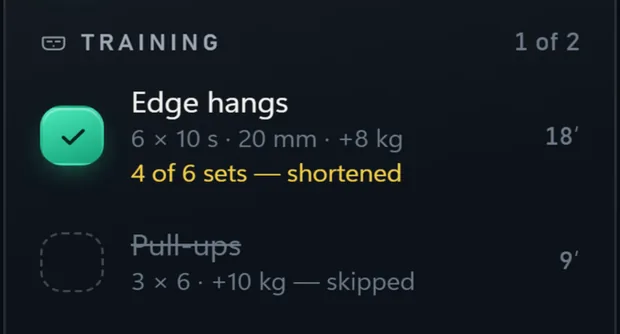
In the app: sets, reps and rest that stay honest. ClimbingDad logs gym work as its own kind of item, next to climbing, hangboard, campus, mobility and cardio. Each set keeps its reps and added load, and ticking a set starts the rest timer, so three minutes of rest stays three minutes. After about two weeks of logged sessions, the app shows fatigue for fingers, forearms, back, shoulders, nervous system and aerobic fitness. How fatigue is calculated. It informs and never blocks a session.
Core exercises for climbing
- Hanging knee raises: 3 sets of 8–12, 90 seconds of rest. No swinging, lower slowly; progress to straight legs.
- Front lever progressions: 3–5 holds of 5–10 seconds, 2 minutes of rest. Tuck, then advanced tuck, one leg out, full lever.
- Plank and side plank: 2–3 holds of 20–45 seconds each, 60 seconds of rest, hips level.
Worth knowing: when Norwegian researchers had advanced climbers train core twice a week for ten weeks, moving exercises and held positions improved climbing-specific core tests by about the same amount. Pick the version you will actually do.
Leg exercises for climbers
Many climbing coaches add one or two leg exercises to the week, because high steps and heel hooks load the legs in a deep knee and hip bend.
- Bulgarian split squats: 3 sets of 8–10 per leg, 90 seconds of rest.
- Pistol squat progressions: 3 sets of 5–8 per leg, holding a door frame at first, 90 seconds of rest.
Mobility and stretching exercises for climbers
- Frog stretch: 2–3 holds of 30–60 seconds, knees wide, hips sinking back.
- Deep squat hold: 2–3 holds of 30–60 seconds, heels down, chest up.
- High step on the wall: 2–3 holds of 20–30 seconds per leg, foot on a hold at hip height or higher.
- Forearm stretches: 2 holds of 20–30 seconds in each direction after climbing, without pain.
Worth knowing: the classic sit-and-reach test barely relates to climbing ability, while a test of how high and wide you can place a foot on the wall does. That is why this list is mostly hips.
A sample week
Finger work goes first in a session, on fresh fingers. Pulling and antagonist work goes after climbing or on its own day. Keep a full day between hard finger days.
Two climbing days:
- Monday: warm-up, max hangs, then climbing.
- Wednesday, gym, 45–60 minutes: pull-ups, rows, push-ups, band pull-aparts, hanging knee raises, split squats, mobility.
- Saturday: climbing, then 10 minutes of finger extensors and external rotation.
Three climbing days:
- Monday: hard climbing, finger work first.
- Tuesday, gym: one pull, two antagonists, one core and one leg exercise.
- Thursday: easier climbing on bigger holds, then mobility.
- Saturday: hard climbing, with no separate finger block. Sunday: mobility.
In your first year, replace the finger block with more climbing. More on the whole week in the climbing training plan.
Common mistakes
- Starting with the campus board before years of finger training.
- Running an advanced protocol just because you can get through it.
- Going to failure on max hangs. Step down before the grip changes.
- Heavy pulling after two hours of projecting. It will be done badly; do it fresh or on another day.
- Too many exercises. One or two per group is a full session.
Questions climbers ask
What exercises should climbers do?
A balanced week has one finger exercise such as max hangs, one pull such as pull-ups, two antagonist exercises such as push-ups and band pull-aparts, one core exercise and some hip mobility. Beginners leave out the finger exercise and climb more.
Can beginners do hangboard training?
A review of resistance training for climbers recommends limiting fingerboard and campus board training in lower-graded climbers because of the high load on the finger flexors. In your first year or so, climbing and bodyweight exercises do more.
How many sets and reps should climbers do?
Typical starting ranges are 3–5 max hangs of 7–10 seconds with 3 minutes of rest, 3–5 sets of 3–8 reps with 2–3 minutes of rest for heavy pulling, and 2–3 sets of 10–15 with about a minute of rest for antagonist and core work.
What are the best core exercises for climbing?
Hanging knee raises, front lever progressions, planks and side planks. In a ten-week study with advanced climbers, moving and held core exercises improved climbing-specific core tests by similar amounts.
Can I do climbing exercises at home?
Yes. Pull-ups on a doorway bar, push-ups, planks, hanging knee raises, band exercises, squats and stretches need little equipment. A home hangboard adds finger training for climbers ready for it.
Train and log with a coach
ClimbingDad is a free app for planning and logging your training. Each hangboard exercise carries its full prescription: sets, reps, hang time, rest, added load and edge depth. An interval timer runs the hangs, and a rest timer starts when you tick a set. From your logged sessions the app estimates how recovered your fingers, pulling muscles and antagonists are; readiness informs, it never forbids. If you train with a coach, the coach panel can read your log but cannot change it. The app works offline, in English and Polish.
About the author. Mateusz Kuba is a sport climbing instructor (instruktor sportu, sport climbing) with C4PC Level 1 — Strength Training for Youths. He coaches climbers on climbing walls in Warsaw and built ClimbingDad.
This page describes training exercises in general terms. It is not medical advice and does not replace a physiotherapist or doctor.
What research says
No study has shown that any exercise on this page prevents climbing injuries. These six papers are behind the rest:
- Heavy finger work in the review. The review calls low-volume, heavy finger training twice a week a feasible approach and advises limiting fingerboard and campus work in lower-graded climbers. Saeterbakken AH, Stien N, Pedersen H, Langer K, Scott S, et al. “The Connection Between Resistance Training, Climbing Performance, and Injury Prevention.” Sports Medicine – Open, 2024. 10.1186/s40798-024-00677-w
- Small weekly steps. Adding 1.25 kg a week for eight weeks improved grip strength more than climbing alone. Mundry S, Steinmetz G, Atkinson EJ, Schilling AF, Schöffl VR, Saul D. “Hangboard training in advanced climbers: A randomized controlled trial.” Scientific Reports, 2021. 10.1038/s41598-021-92898-2
- Finger extensors. Four weeks of extension training twice a week raised extension strength by about 41%. Devise M, Pasek L, Goislard de Monsabert B, Vigouroux L. “Finger flexion to extension ratio in healthy climbers: a proposal for evaluation and rebalance.” Frontiers in Sports and Active Living, 2023. 10.3389/fspor.2023.1243354
- Core. Dynamic and isometric core training improved climbing-specific core tests similarly; the study had no untrained group. Saeterbakken AH, Loken E, Scott S, Hermans E, Vereide VA, Andersen V. “Effects of ten weeks dynamic or isometric core training on climbing performance among highly trained climbers.” PLoS One, 2018. 10.1371/journal.pone.0203766
- Hip mobility. A foot-raise test related to climbing ability, sit-and-reach did not. Draper N, Brent S, Hodgson C, Blackwell G. “Flexibility assessment and the role of flexibility as a determinant of performance in rock climbing.” International Journal of Performance Analysis in Sport, 2009. 10.1080/24748668.2009.11868465 (university repository copy)
- Order. The exercise you do first in a session gets the most out of you, so put the hardest work first. Simão R, de Salles BF, Figueiredo T, Dias I, Willardson JM. “Exercise order in resistance training.” Sports Medicine, 2012. PubMed 22292516