Training guide · Board
Board training: Kilter, MoonBoard and Tension, the rules and three sessions
How the three boards differ, how to use them, three board sessions with attempts and rest, and the mistakes that waste them


Build your training yourself or with a coach.
In short
- A board is a standard wall. The same holds in the same places, so a problem is the same every time and your sessions compare.
- Three kinds of session: limit problems for strength and power, easy problems for footwork, and a pyramid for volume.
- A hard board session is a heavy finger day. Treat it like max hangs and keep it away from other hard finger days.
- Same board, same angle. Compare grades and sends only on the setup you trained on.
Board climbing training means climbing set problems on a standard wall: a MoonBoard, a Kilter Board, a Tension Board, a home system board or a spray wall. This page explains how the boards differ, the rules most people climb by, and three board sessions. The attempts, rests and grades in the sessions are common coaching ranges. Measured facts from studies are in the science section, with sources at the end. Where a board fits in your week is in the climbing training plan.
System boards, spray walls and LED boards
- System board. A steep wall with holds placed in a regular, often mirrored pattern, so you can repeat the same move on both sides.
- Spray wall. A steep wall densely covered with holds in no pattern. You and your gym set the problems, often in an app or on a list.
- LED board. A standard layout with a light under each hold and an app that holds thousands of problems. The MoonBoard, the Kilter Board and the Tension Board are the common ones. Which app does what is in best climbing apps.
- Not a campus board. A campus board has wooden rungs and no feet, and it is a separate tool with its own rules. See campus board training.
MoonBoard vs Kilter Board vs Tension Board
Product facts from the manufacturers’ pages. Checked on 3 November 2026.
- MoonBoard: a standardised wall at 25° or 40°. The 2016, 2017, 2019 and 2024 setups can be built at either angle; the Mini MoonBoard setups of 2020 and 2025 are 40° only. Grades are in Font or V, set in the app.
- Kilter Board: an adjustable angle. The manufacturer’s clearance charts run from 0° to 70° in 5° steps. Two layouts: the Original and the denser Homewall (Fullride). The app lists over 160,000 climbs.
- Tension Board 2: one hold set in two layouts. The Mirror layout lets you climb each boulder and its mirrored version; the Spray layout is a spray wall. Holds are wood and polyurethane, the angle is adjustable, and the app lists over 40,000 climbs.
What it means for training. On a MoonBoard the angle never changes, so a problem stays the same problem. On a Kilter or Tension Board, the angle is part of the problem: record it with every session, or your numbers stop being comparable. Setter Closet describes lower angles for technique and steep angles for power.
How to use a Kilter Board and the other boards
- Pick the setup. In the board’s app, choose the right board, layout and, on an adjustable board, the angle.
- Light the problem. The app lights the holds of the problem you pick.
- Read the roles. Each lit hold is a start hold, a hand-and-foot hold, a foot-only hold or a finish hold. On a Kilter Board the roles are shown by color. Read the key at your board, since the keys gyms post do not all match.
- Climb by the rules of that board. See below.
MoonBoard rules, as Moon Climbing states them. All problems start with two hands; if there is one start hold, you start matched. All problems finish on the top row, and you hold the finish in control for 2 seconds. Which footholds you may use is set per problem in the app, from any marked holds to footless. Kickboard footholds are allowed unless the problem says otherwise. Benchmark problems are curated by moderators. Checked on 3 November 2026.
Kilter Board rules. The Kilter pages we checked do not publish rules. If your gym posts its own, follow those. Otherwise use only the lit holds in their roles and hold the finish in control.
Board grades
- A separate scale. Board grades come from the board’s users on that setup. Do not expect them to match your gym’s circuit grades.
- Start with benchmarks. On a MoonBoard, benchmark problems are the curated ones and a fair place to find your level.
- Find your board max. The hardest problem you can send in a session within a few attempts. Every session below is set relative to it.
- The angle changes the grade. On an adjustable board, a problem at 40° and the same holds at 25° are two different problems.
Board climbing training: three sessions
After a full warm-up, as in climbing warm-up. “Max” means your board max on that setup and angle.
Session 1: limit problems
- What: 3 to 5 short problems at or near your max, then a couple at max −1.
- Attempts: up to 4 or 5 per problem. Move on when attempts stop getting better.
- Rest: 3 to 5 minutes between attempts. Short problems on a steep board are close to full effort on every move.
- Stop: when moves get sloppy or a finger complains. The session is usually 45 to 60 minutes of climbing.
Session 2: footwork on easy problems
- What: 6 to 10 problems about three grades below your max.
- Drills: press the foothold before every hand move; place each foot silently; let go with one hand and hold the position for a few seconds; after a cut loose, stop the swing and put your feet back on.
- Rest: 1 to 2 minutes. The effort is low; the point is precision.
Session 3: a volume pyramid
- What: 4 problems at max −3, 3 at max −2, 2 at max −1, then 1 or 2 attempts at max.
- Rest: 2 to 3 minutes between problems, longer before the top of the pyramid.
- Who: climbers who send their max problems but fall off a long sequence of hard moves.
Test your board max at the start and end of a training block, on the same setup and angle, within a fixed number of attempts. Between tests, change one thing at a time.
Fitting the board into your week
A limit session on a steep board loads small holds hard, close to a hangboard session. Count it as a heavy finger day. Do not put it the day after max hangs or another limit session, and do the board before the rest of the climbing, not at the end. The footwork session is lighter and fits on a day you would otherwise climb easily. If you also hangboard, protocols and spacing are in hangboard training. How to lay out the whole week, with sample weeks, is in the climbing training plan.
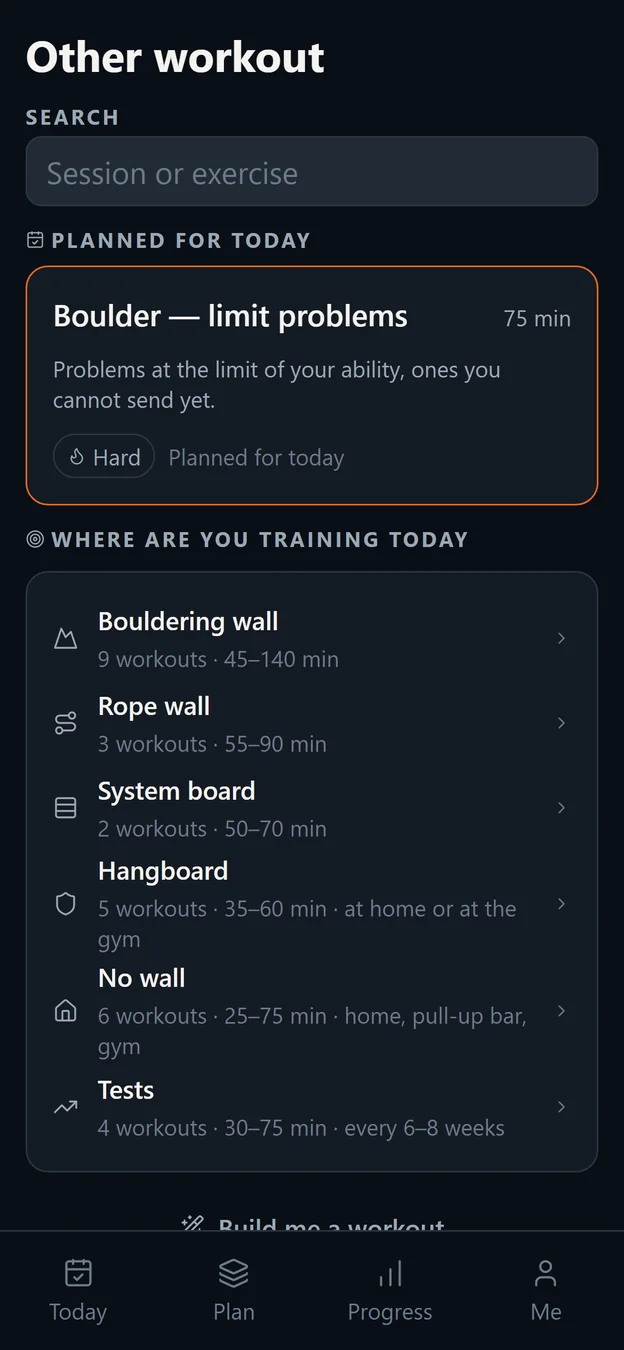
In the app: ClimbingDad has a system board place among its workouts, next to the bouldering wall, rope wall, hangboard and no wall. Built-in board sessions include limit problems (short problems close to your max, then a few at max −1), footwork (foot before every hand move, silent feet and hand-off holds, with cut loose and recover as an option), a board max test on the same set and angle, and a session that pairs max hangs with board footwork. The limit session tells you your fingers need three days off afterwards, as after the hangboard. Every climb is logged with a grade and a result. ClimbingDad does not hold board problems or light them up: pick the problems in the board’s app and log the session here.
Common mistakes
- Every session at your limit. Add footwork and pyramid sessions, or the board becomes just another finger day.
- Changing the angle every week and then comparing grades.
- Short rests on limit problems. A rushed attempt is a worse attempt and a tired finger.
- The board at the end of a session, on tired fingers.
- Hard board days back to back, or the day after max hangs.
- Full crimping everything. Steep boards invite it. Use open hand and half crimp where you can.
- Projecting one problem for the whole session. Cap the attempts and come back next time.
- Ignoring your feet. On a steep board, feet that cut loose are a habit worth a session of its own.
What studies measured on boards
Board training is barely studied. In a five-week pilot trial, 13 advanced female boulderers were split into two groups. One replaced 30 minutes of their climbing, twice a week, with ten prescribed problems on a Kilter board; the other kept bouldering as usual. Experts rated videos of two test problems. Both groups improved a little, the board group mainly in balance and sequencing on one problem, and there was no significant difference between the groups. The authors call the study preliminary.
Bouldering and intensity carry injury risk. A systematic review of 34 studies in adult climbers linked bouldering, higher climbing intensity, lower finger strength, crimping and a previous injury to a higher risk of overuse injury. Hard board climbing is bouldering at high intensity, often on crimps.
Crimping loads the pulleys more. In donated fingers loaded until something tore, forces on the A2 pulley averaged 287 N in a crimp and 121 N with a slope grip. The A4 pulley tore in half of the crimp trials and never in the slope position.
Questions climbers ask
MoonBoard vs Kilter Board: which is better for training?
Neither is better in general. A MoonBoard is built at a fixed 25° or 40°, so a problem is the same on every MoonBoard with that setup and angle. A Kilter Board has an adjustable angle, so one board covers easy technique work and steep power work. Pick the board your gym has and train on the same one, at the same angle, so your sessions compare.
What do the colors mean on a Kilter Board?
Each lit hold has a role: start, hands and feet, feet only, or finish. The Kilter pages we checked do not publish the color key, and the keys gyms post do not all match, so read the key at the board you climb on before your first problem.
How often should you do board climbing training?
Once or twice a week for most climbers who train. Count a hard board session as a heavy finger day, like max hangs on a hangboard, and do not put it the day after another one. Easy footwork sessions on the board are lighter.
Are board grades harder than gym grades?
They are a different scale. A board grade comes from the board’s own users and setup, at a given angle. Compare your board grades only with your board grades, on the same setup and angle, and do not expect them to match the grades on your gym’s circuits.
Is a board good for beginners?
A board at a low angle, on problems well below your limit, is good footwork and body tension practice. Hard problems on a steep board load the fingers heavily on small holds, which is a job for climbers with a training base. Start low and easy.
Train and log with a coach
ClimbingDad is a free climbing training app for training on your own or with a coach. A coach can plan your week and leave a note on a session, which shows on that day’s card. The coach reads your log. The app is free; you only pay if you train with a coach, at a price the coach sets. More on training with a coach.
About the author. Mateusz Kuba is a sport climbing instructor (instruktor sportu, sport climbing) with C4PC Level 1 — Strength Training for Youths. He coaches climbers on climbing walls in Warsaw and built ClimbingDad.
This page describes board training in general terms. It is not medical advice and does not replace an examination by a doctor or physiotherapist.
What research says
The measured facts on this page come from these three papers. Only one of them tested board training, in 13 climbers. Product facts come from the manufacturers’ pages, checked on 3 November 2026:
- Five weeks on a system wall. 13 advanced female boulderers; small gains in both groups, no significant difference between them. Stien N, Langer K, Andersen V, Engelsrud GH, Olsen E, Saeterbakken AH. “Development of Specific Motor Skills through System Wall Bouldering Training: A Pilot Study.” Translational Sports Medicine, 2024. 10.1155/2024/5584962 (PMID 39015173)
- Overuse injury risk in adult climbers. 34 studies; bouldering, higher intensity, lower finger strength, crimping and a previous injury linked to higher risk. Quarmby A, Zhang M, Geisler M, Javorsky T, Mugele H, Cassel M, Lawley J. “Risk factors and injury prevention strategies for overuse injuries in adult climbers: a systematic review.” Frontiers in Sports and Active Living, 2023. 10.3389/fspor.2023.1269870 (PMID 38162697)
- Grip position. A2 pulley force 287 N in a crimp and 121 N with a slope grip; the A4 pulley tore in half of crimp trials. Schöffl I, Oppelt K, Jüngert J, Schweizer A, Neuhuber W, Schöffl V. “The influence of the crimp and slope grip position on the finger pulley system.” Journal of Biomechanics, 2009. 10.1016/j.jbiomech.2009.04.049 (PMID 19665129)
- MoonBoard angles and rules. Moon Climbing, using your MoonBoard and what is the MoonBoard.
- Kilter Board angles, layouts and app. Setter Closet, Kilter Board help and Kilter Board overview.
- Tension Board 2 layouts, holds and app. Tension Climbing, TB2 details.